

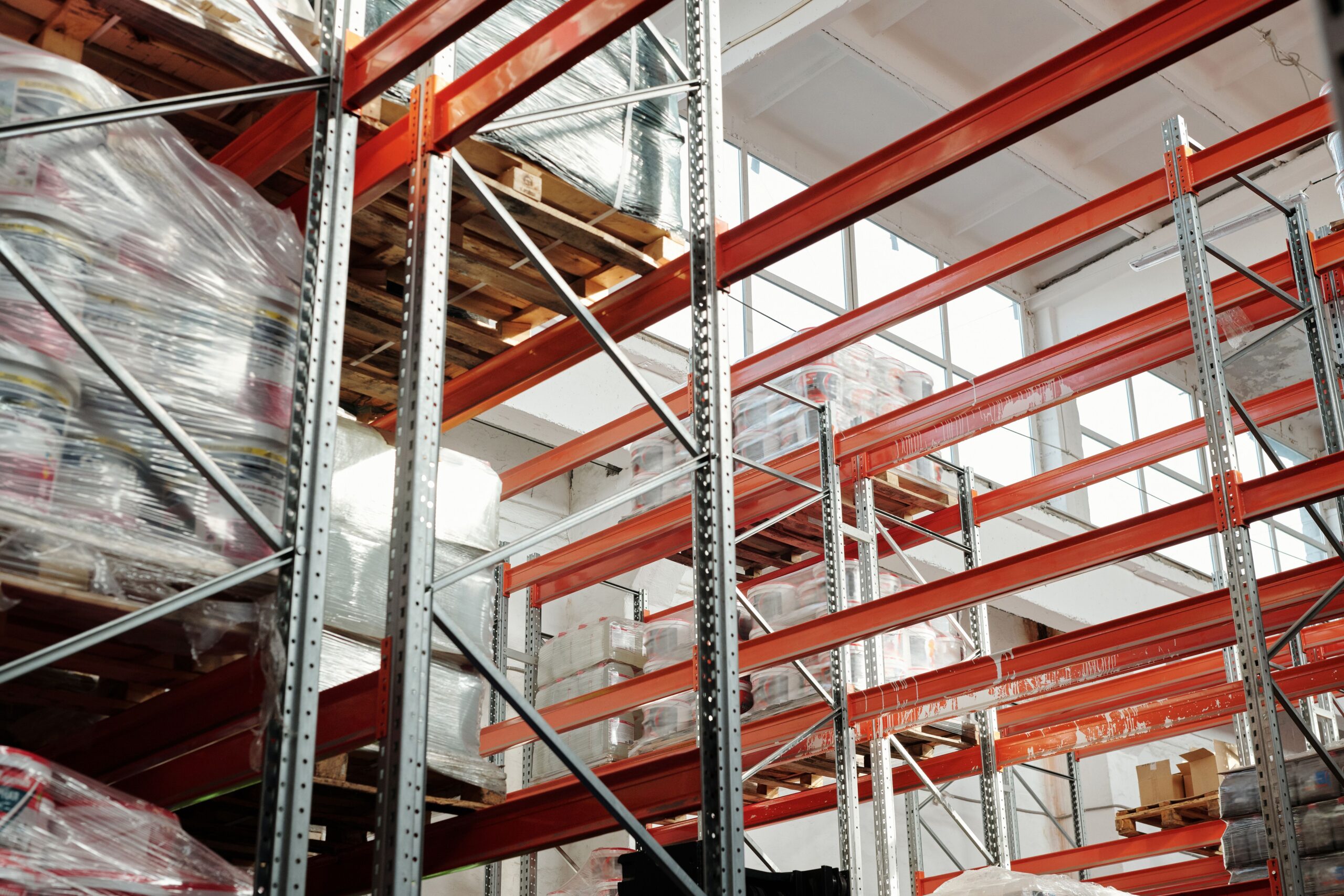
Preparing a facility for liquidation starts with documenting every asset on the floor before anyone quotes a price, since buyers pay for what they can verify: counts, capacities, condition, and dimensions. Facilities that inventory their racking, shelving, and material handling equipment up front recover more value and clear the building faster. A&A Surplus buys used systems outright and handles teardown and removal nationwide from its Plantsville, CT yard. Here's what to document, how to sequence the exit, and when to bring a buyer in.
Nobody calls a buyer when things are going well. By the time warehouse liquidation is on the table, there's usually a hard deadline attached: a lease expiration, a bankruptcy filing, a facility consolidation with a move-out date somebody upstream picked without asking the guy who actually has to clear 40,000 square feet of racking.
That's the context most liquidation conversations happen in. And it's exactly why sellers consistently get less than they should.
Not because buyers are sharks. Because sellers show up unprepared. They don't know what they have, they don't know what it's worth, and they don't know which type of buyer is even the right call for their situation. So they take the first offer.
This piece walks through what you need to know before you pick up the phone.
What your equipment is actually worth, and what changes that number
Used warehouse equipment doesn't have a fixed market price. What a buyer will pay depends on a handful of factors, and two facilities with identical square footage can get wildly different offers based on what's sitting inside.
Brand. Not all pallet racking has the same resale demand. Interlake, Ridg-U-Rak, Unarco, and Frazier are established brands with components and system types that buyers can identify and price more readily. Generic or import racking from no-name manufacturers is harder to move and prices accordingly. If you don't know who made your frames and beams, that's the first thing to find out.
Condition. If you find damaged pallet racking, especially a bent upright or damaged connection, expect it to reduce the offer. Buyers inspect every column during the facility walkthrough. Minor contact damage on a handful of uprights is normal and usually gets absorbed. Systematic damage, where half the frames show forklift hits, changes the math.
Configuration. A rack system that's been set up intelligently, with consistent bay widths and standard beam lengths, is worth more than a Frankenstein mix of mismatched parts from three different eras. Standard configurations are easier to resell as a complete system. Custom or oddball setups get broken down and sold as components at lower per-piece prices.
Steel type. Wire decking, pallet supports, and row spacers can add value when their sizes match the rack system and they remain in saleable condition. More importantly, the base material matters. Standard teardrop racking in common 8-foot, 10-foot, or 12-foot frame heights moves fast. Specialty heights or custom-drilled uprights are slower to place and typically fetch less.
One thing that catches sellers off guard: quantity doesn't automatically mean more money. A buyer who can only absorb so much inventory of a particular type will lower their per-unit price once they hit their limit. This is why understanding the buyer's business model matters, which we'll get to.
If a relocation or consolidation also requires replacement equipment, compare the cost of used versus new pallet racking before setting the project budget.
How to inventory your equipment before anyone shows up
Buyers need information to make an offer. The more complete your inventory, the faster the process moves and the fewer surprises show up on valuation day.
Here's what you need:
- Frame count and dimensions. Height and depth on every upright. Count the frames, not the bays, since a bay has two frames sharing a column.
- Beam count and lengths. Measure a sample set and confirm they're consistent. Note the capacity ratings if you have them (usually stamped on a label near the connection point).
- Wire deck or board count. Note condition and whether they match the beam spans.
- Accessories. Row spacers, column guards, pallet supports, foot plates. These get overlooked and can add up.
- Mezzanine or specialty structures. Document mezzanines, warehouse conveyor systems, and other built-out structures separately. Record their dimensions, controls, configuration, and visible condition because they take longer to value and may sell through different channels.
- Condition notes. Walk the floor with a phone and photograph any damage. Don't hide it, buyers will find it anyway, and showing it upfront builds trust and speeds the process.
You don't need a formal spreadsheet. A text file or even a voice memo walking through the totals works fine. What doesn't work is "I think we have a lot of rack." That tells a buyer nothing.
Photos are worth more than descriptions. Take wide shots of full runs, close-ups of any visible damage, and shots of the beam capacity labels if you can find them. A buyer like A&A Surplus can often give a preliminary range based on photos alone before scheduling an on-site visit. That saves everyone time.
Brokers vs. direct buyers: the difference matters more than you think
There are two ways to sell used warehouse equipment: through a broker or directly to a buyer. Most sellers don't know there's a difference, and it costs them.
The right sales path depends on your deadline, the equipment involved, and how much transaction certainty you need. A broker can market equipment to prospective buyers, while a direct buyer purchases the assets and can establish the payment and removal terms with you.
| Factor | Broker | Direct buyer |
|---|---|---|
| Transaction structure | Markets the equipment and connects the seller with a downstream buyer | Purchases the equipment from the seller |
| Equipment ownership | Typically does not take ownership before arranging a sale | Takes ownership under the agreed purchase terms |
| Timeline | Can involve a longer marketing and buyer-matching period | Can provide a defined offer, payment schedule, and extraction plan |
| Payment | May depend on the downstream sale closing | Is tied to the direct transaction and its agreed schedule |
| Removal coordination | May involve the broker, end buyer, and a separate labor crew | Can be handled with one buyer when teardown and extraction are included |
| Best fit | Sellers with more time or specialized assets that may benefit from wider exposure | Sellers facing a lease exit, consolidation, bankruptcy, or other fixed move-out date |
| Questions to ask | What are the fees, payment trigger, marketing period, and removal responsibilities? | What is included in the offer, when is payment made, and who handles teardown, hauling, and floor work? |
Neither route is automatically right for every facility. Compare the net proceeds, payment trigger, removal scope, and schedule before signing an agreement.
Brokers list your equipment and find buyers. They don't take ownership, they connect you to someone who will. In theory, this means wider exposure and potentially higher prices. In practice, it means slower timelines, more moving parts, and a cut that reduces your net. If you've got six months and no lease pressure, a broker might be worth exploring. If you've got 45 days to be out of the building, a broker is almost certainly the wrong call.
Direct buyers purchase your equipment outright. The offer might be lower on paper, but the transaction is clean: one party, one check, one extraction timeline you can actually plan around. For anyone dealing with a lease expiration, a bankruptcy proceeding, or any situation where speed and certainty matter, direct is almost always the right answer.
Payment timing is the other difference that gets glossed over. Brokers typically pay after resale, which can be weeks or months out. Direct buyers pay on a defined schedule tied to the transaction itself, not to what happens downstream.
A&A Surplus buys used material handling equipment directly, with no middle layer, no consignment, no waiting on a downstream buyer to close.
What "broom-clean" actually means
If you're clearing a facility to exit a lease, your lease almost certainly contains a broom-clean clause. This comes up constantly in liquidation conversations and causes more confusion than it should.
Broom-clean doesn't mean spotless. It means the space is free of debris, your personal property is removed, and the facility is in roughly the condition it was in when you took occupancy, normal wear and tear excepted.
What it does mean practically: all the racking and equipment comes out. Anchored systems get unbolted, holes get addressed per your lease terms, and the floor gets swept. You can't leave behind the systems you couldn't sell and call it good. That's abandonment, and most landlords treat it as such.
The timing matters too. If you're planning a clearance and working with a buyer's extraction timeline, make sure you've built in enough buffer to address any floor remediation your lease requires before the final walkthrough. A missed detail here can turn a clean exit into a security deposit fight.
A&A's warehouse equipment teardown and relocation services can include the full extraction and unbolting of anchored systems. Confirm in writing who will dismantle, band, load, haul, treat floor holes, remove debris, and complete the work before the final walkthrough.
How A&A Surplus handles a buy
The process isn't complicated, but knowing what to expect upfront keeps things moving.
Step one: the call. You reach out, describe what you have in general terms: rough square footage, type of equipment, whether it's racking, shelving, material handling, or a mix. We'll ask a few questions to understand the scope.
Step two: photos. Before we schedule anything on-site, we want to see the equipment. Clear photos of the rack runs, any damage, and ideally the frame heights and beam lengths. This lets us come in with a real sense of value and use the on-site time productively rather than doing a basic inventory from scratch.
Step three: on-site valuation. One of our buyers walks the floor, confirms the count, checks condition, and puts together an offer. For most standard rack systems, this takes a few hours. Larger, more complex facilities may take a full day.
Step four: extraction timeline. Once we agree on a price, we schedule the pull. Depending on volume and our current workload, that's typically within a few weeks. We'll work with your move-out date if there's a hard deadline, and that's a normal part of the conversation, not a special request.
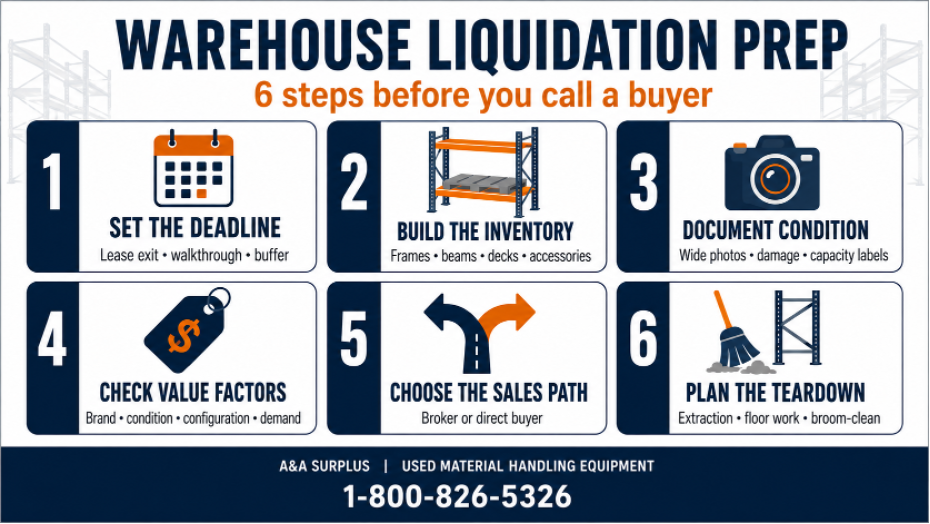
That's it. No mystery. The variables that affect how fast and how clean this goes are the ones already covered above: how complete your inventory is, how well-documented the condition is, and whether you've got a realistic timeline in mind.
If you need to sell used pallet rack or other material handling equipment, clear a full facility, or identify equipment before it has to go, contact A&A Surplus with your photos, rough counts, facility location, and move-out date.
One thing worth knowing before you call anyone
The facilities that get the best outcomes in liquidation are the ones that treat the process like a transaction, not a disposal. The mindset shift matters. You're not paying someone to haul away a problem. You're selling assets, and how you present those assets affects what you get for them.
Buyers notice when a seller has done their homework. It's not just about the numbers, it's about whether the conversation can move fast. A seller who knows their frame count, can show photos, and has a real move-out date in mind is a much easier deal to make than one who says "we have a bunch of stuff and we need it gone."
Do the prep. It takes a few hours and it pays.
Frequently asked questions about facility liquidation
These answers address the practical questions facility owners and operations teams often need resolved before requesting an equipment valuation.
What information should I collect before requesting a facility liquidation quote?
Record the count and dimensions of rack frames and beams, the number of wire decks or boards, capacity labels, accessories, specialty structures, and visible damage. Include your facility size, location, access conditions, and move-out deadline. A complete inventory helps the buyer assess scope, identify resale value, and plan an on-site review.
How is used warehouse equipment valued during liquidation?
Buyers consider the manufacturer, condition, configuration, dimensions, included accessories, quantity, and current resale demand. Standard rack sizes and consistent systems are generally easier to resell than damaged, custom, or mismatched components. Large quantities can also affect the per-unit offer if a buyer cannot readily absorb all of the inventory.
Should I use a broker or sell directly to a warehouse equipment buyer?
A broker may suit a seller with a longer timeline who wants the equipment marketed to multiple prospective buyers. A direct buyer is often better suited to a fixed facility-exit deadline because the purchase, payment terms, and extraction schedule can be agreed with one party. Compare net proceeds and responsibilities, not just the headline offer.
What photos should I take before a warehouse liquidation?
Take wide photos showing complete rack runs and the overall facility layout. Add close-ups of frame and beam connections, manufacturer markings, capacity labels, accessories, and any bent or damaged components. Clear photos can help a buyer develop a preliminary value range and prepare for a more efficient on-site inspection.
What does broom-clean mean when leaving a warehouse?
Start with the exact language in your lease. In practical terms, broom-clean commonly means removing your equipment and personal property, clearing debris, and sweeping the space. Anchors, floor holes, repairs, or other restoration work may be governed by separate lease terms, so confirm those requirements before scheduling the final walkthrough.
When should I begin planning a facility liquidation?
Begin as soon as the closure, consolidation, or lease-exit date is known. Work backward from the final walkthrough and reserve time for inventory, valuation, offer review, extraction, floor work, and cleanup. A&A Surplus notes that extraction is typically scheduled within a few weeks after an agreement, depending on volume and workload, so a reasonable buffer protects your options.
Does A&A Surplus handle warehouse equipment teardown and extraction?
Yes. According to the company's facility liquidation guidance, A&A Surplus provides teardown services that include unbolting anchored systems and completing the extraction. Confirm the equipment scope, access conditions, hauling responsibilities, floor-hole treatment, cleanup standard, and completion date in the written agreement for your project.
Save 30-50% vs. New Equipment
Quotes Built Around Your Space
Ships Same Week From Plantsville, CT
Ready To Upgrade Your Warehouse?
Stop waiting on extended manufacturer lead times. Get the storage capacity you need right now from A&A Surplus Inc. – in business since 1939, BBB Accredited, A+ Rating.
Or call us directly: 1-800-826-5326 | Mon-Fri 7:30 a.m. – 4 p.m.