

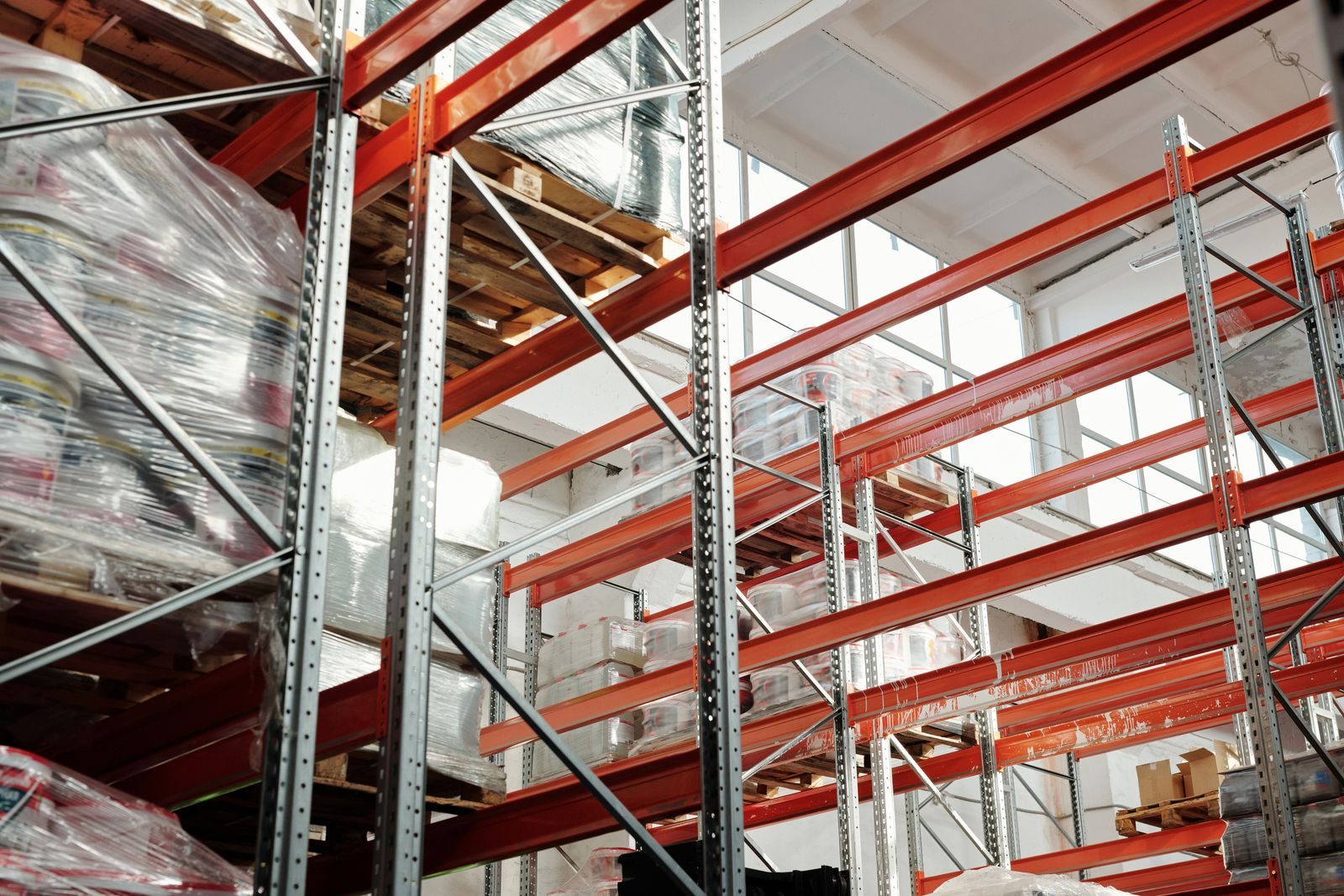
Damaged pallet racking gets replaced, not straightened. Once a steel upright bends, the metal has yielded, and pulling it back with a pry bar doesn’t restore the load rating it shipped with. OSHA has no racking-specific standard, so inspectors fall back on the General Duty Clause and ANSI MH16.1 from the Rack Manufacturers Institute. A&A Surplus inspects and replaces damaged racking across the Northeast. Here’s how to tell repairable damage from a column that has to come out.
A forklift clips an upright. The column bows out maybe an inch at knee height. Somebody grabs a pry bar, muscles it back to roughly straight, and the shift keeps moving. I’ve watched that exact scene play out in warehouses that were otherwise run by careful, competent people.
Here’s the problem. A steel upright that’s been bent and bent back is not the same upright it was the day it shipped. The metal yielded. You can’t un-yield it with a pry bar.
That “push it back into shape” instinct is one of the most expensive habits in warehousing, and almost nobody treats it that way until a beam lets go.
What the Rules Actually Say (and Don’t)
People love to ask what OSHA requires for pallet racking. The honest answer surprises them. OSHA has no specific racking standard. No dedicated regulation telling you how much column deflection is too much, no mandated inspection interval written into the code.
That’s not the loophole it sounds like.
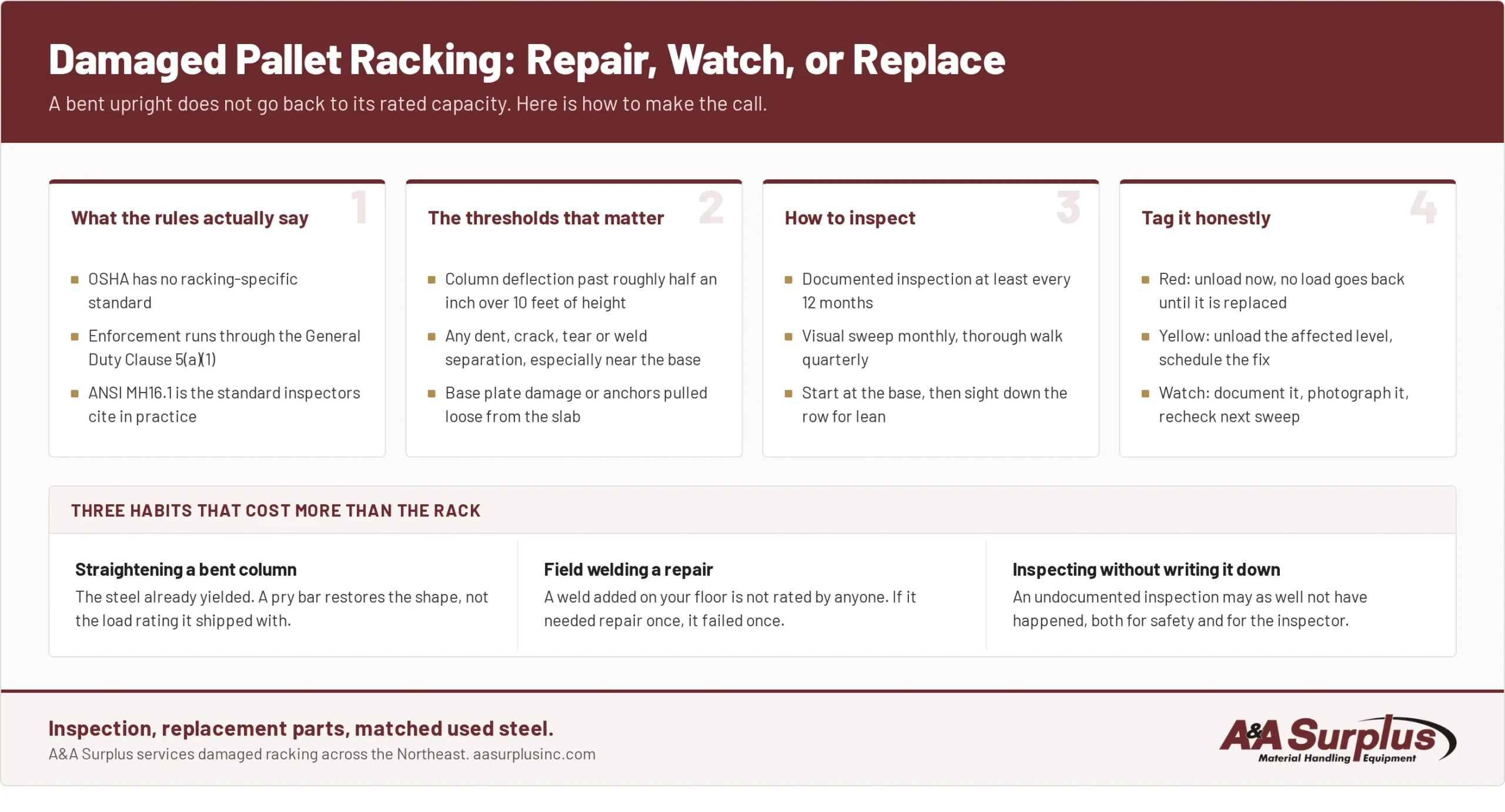
OSHA enforces racking through the General Duty Clause, Section 5(a)(1), which obligates every employer to keep a workplace “free from recognized hazards that are causing or are likely to cause death or serious physical harm.” Damaged racking is a recognized hazard. So when an inspector needs a yardstick for what “recognized” means, they reach for the industry consensus standard: ANSI MH16.1, published by the Rack Manufacturers Institute. OSHA references it directly in citations. Treat it as the rulebook even though it lives outside the federal code, because in practice it is the rulebook.
MH16.1 covers the design, testing, and use of industrial steel storage racks. The part that matters for damage assessment is straightforward once you know where to look. A few of the thresholds it informs:
- Column deflection beyond roughly half an inch over a 10-foot run of upright height. That’s the common trigger. A bowed column carrying load is a column doing something the engineer never sized it for.
- Any dent, crack, tear, or weld separation, particularly near the base where the load concentrates.
- Base plate damage or anchors pulled loose from the slab.
None of those numbers mean much if you only read them once. The point is to internalize the half-inch figure and the base-plate rule, then walk your aisles with them in your head.
How to Actually Inspect a Rack Without Overthinking It
You don’t need an engineering degree to run a competent walkthrough. You need consistency and a flashlight.
MH16.1 expects a documented inspection at least every 12 months. I’d argue annual is the floor, not the goal. Most operations that move real volume should be doing a quick visual sweep monthly and a thorough one quarterly, with the formal documented inspection layered on top.
Start at the floor. The base of an upright takes the worst of forklift contact and carries the highest stress, so it tells you the most. Look at the base plate. Look at the anchors. Look at the first three feet of column for dents and bows.
Then work up. Check the beam-to-column connectors, the safety clips that are supposed to be seated and so often aren’t, the beams themselves for deflection under load. Sight down a row of uprights like you’re checking a rifle barrel. A column that’s out of plumb jumps out when you look down the line even if it hides when you stare at it head-on.
Write down what you find. Photograph it. An undocumented inspection might as well not have happened, which is something I learned watching a client try to explain to an insurance adjuster why there was no record of the rack that collapsed.
Red Tag, Yellow Tag, or Watch It
Once you’ve spotted damage, you have to categorize it, and this is where the discipline lives. Three buckets.
Red is unload now. The component is compromised to the point where continued loading risks failure. Beam knocked off its connector, an upright with a visible crack or a base that’s torn, deflection well past the threshold. You pull product off it before the end of the shift and you don’t reload until it’s repaired or replaced. No debate.
Yellow means damaged but not at immediate-failure risk. Plan the fix. You keep using it short term, but the clock is running and you’ve committed to a repair or swap on a real timeline, not a someday.
Monitor is the lightest tier. Minor cosmetic stuff, a scuff, a shallow ding that’s nowhere near a threshold. You note it, you photograph it, you check it next round to confirm it isn’t getting worse.
The trap is tag inflation in the wrong direction. Managers under pressure to keep slots full talk themselves into calling a red condition yellow. That bent upright at knee height from the opening of this post? That’s almost always a red tag wearing a yellow disguise.
| Tier | Red tag | Yellow tag | Monitor |
|---|---|---|---|
| What it looks like | Cracked weld, torn base plate, beam off its connector, deflection well past threshold | Real damage that is not at immediate failure risk, such as a dented column holding load | Scuffs, shallow dings, paint loss with no deformation |
| What it means | The component can fail under load | The rating is questionable and the clock is running | Cosmetic, no measurable loss of capacity |
| Action | Unload before the end of shift, do not reload | Keep using short term, schedule the swap | Photograph it and check it again next sweep |
| Timeline | Same day | A committed date, not someday | Next scheduled inspection |
| Who decides | Anyone on the floor can call it | Whoever owns the inspection record | Whoever owns the inspection record |
When Repair Is Fine and When It’s Lying to You
Plenty of rack damage is genuinely repairable. There’s a whole industry of engineered repair kits, bolt-on column reinforcements, and certified weld repairs, and a lot of it is legitimate and cost-effective.
But repair has a ceiling.
A repair has to be engineered for the specific load, the specific column, the specific damage. A reinforcement kit slapped on without anyone confirming it restores the original rated capacity isn’t a repair. It’s a paint job over a structural problem. And here’s the line I hold: once a column has yielded badly, once the steel has actually deformed past its elastic limit, you’re not repairing it, you’re hoping. That’s replacement territory.
Bent it back into shape with a pry bar counts as hoping. So does welding a plate over a crack without an engineer’s stamp.
The Math Nobody Runs Until It’s Too Late
Let’s talk money, because that’s the real reason the pry-bar approach survives.
A replacement upright might run a few hundred dollars. A full bay’s worth of components, more. Tearing down and reconfiguring a section, more again. Those are visible, annoying, this-quarter costs, and they’re the costs managers actually feel.
The cost of doing nothing is invisible right up until it’s catastrophic. A rack collapse doesn’t politely take out one bay. Loaded racking fails like dominoes, one section pulling the next, and now you’ve got crushed product, a damaged building, downtime measured in days, and potentially someone in an ambulance. After that comes the OSHA citation under the General Duty Clause, the insurance fight over whether you knew, and the wrongful-something lawsuit if anyone was standing in the aisle.
A few hundred dollars against all of that. Run the comparison honestly and the bent upright stops looking like a budget line and starts looking like the cheapest insurance you’ll ever buy. Most people skip this part and wonder why their CFO doesn’t approve rack budgets.
Frequently asked questions
When should damaged pallet racking be replaced instead of repaired?
Replace whenever the steel has yielded. A bent column, a cracked weld, a torn base plate, or an upright that took a hit at the base all get replaced, because bending steel back does not restore the rating it shipped with. Repair kits suit specific, engineered situations, not everyday forklift damage.
How much column deflection is too much?
The common trigger is roughly half an inch of deflection over a 10 foot run of upright height. Past that, the column is carrying load in a shape the engineer never sized it for. Base plate damage and pulled anchors are automatic red tags regardless of how straight the column looks.
Does OSHA have a pallet racking standard?
No dedicated standard exists. OSHA enforces racking through the General Duty Clause, Section 5(a)(1), and falls back on ANSI MH16.1 from the Rack Manufacturers Institute as the industry consensus yardstick. MH16.1 is referenced directly in citations, so treat it as the rulebook in practice.
How often should pallet racking be inspected?
MH16.1 expects a documented inspection at least every 12 months. Operations moving real volume should run a quick visual sweep monthly and a thorough one quarterly on top of that. Write down and photograph what you find, because an undocumented inspection may as well not have happened.
Where A&A Surplus Fits
This is the part where sourcing matters, because the framework above only works if replacement is actually fast and affordable.
A&A Surplus carries pallet rack components, uprights, beams, the works, in new and used, so a red-tagged bay doesn’t sit empty for six weeks waiting on a factory lead time. Need a single matching upright to swap out a damaged one? We probably have it. Need a whole system reconfigured or installed? That’s what our installation services are for.
And if an inspection tells you a section is past saving, there’s a back door most managers forget. AA Surplus buys used material handling equipment. So the teardown of a compromised system can offset the cost of its replacement. We’ll purchase the used racking you’re pulling out and put credit toward what goes back in.
The one thing I won’t tell you is exactly which repair kits are worth it for your specific setup, because that depends on your loads, your seismic zone, and your manufacturer, and anyone who answers that question without seeing your racks is guessing.
Save 30-50% vs. New Equipment
Quotes Built Around Your Space
Ships Same Week From Plantsville, CT
Ready to Upgrade Your Warehouse?
Stop waiting on extended manufacturer lead times. Get the storage capacity you need right now from A&A Surplus Inc. – in business since 1939, BBB Accredited, A+ Rating.
Or call us directly: 1-800-826-5326 | Mon-Fri 7:30 a.m. – 4 p.m.