

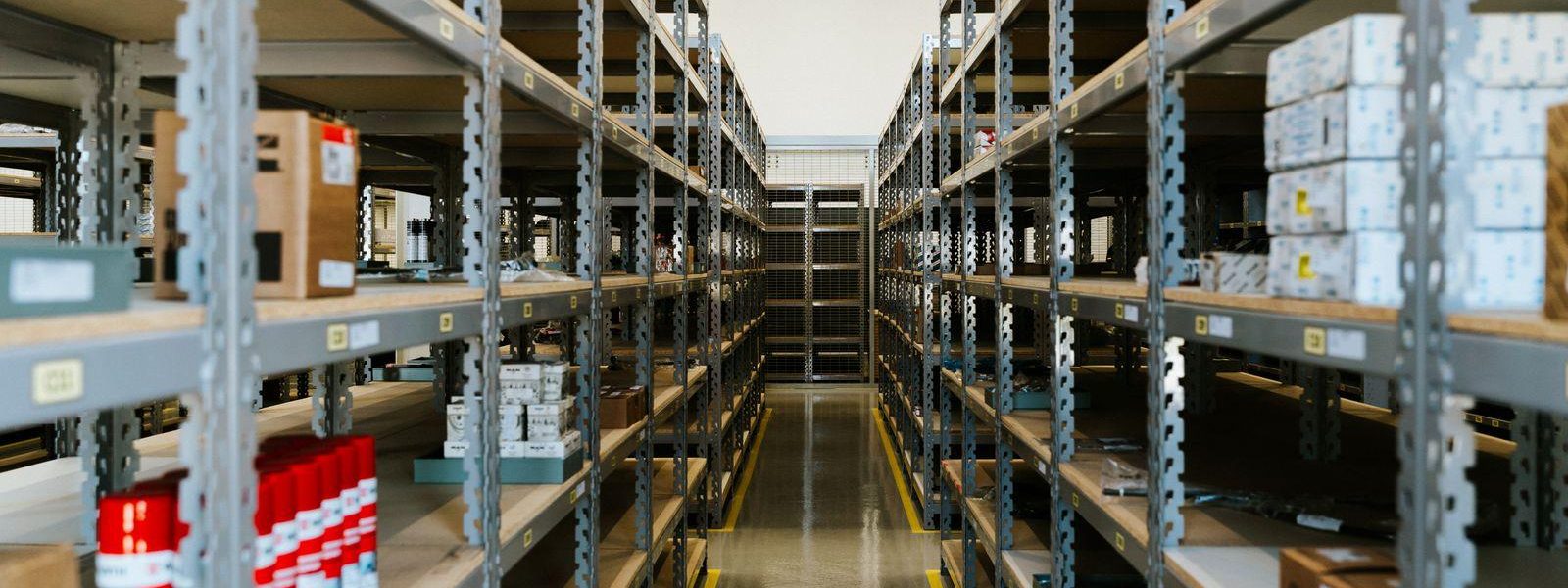
Used industrial shelving is a good buy when the posts are straight, the shelves are flat and no hardware is missing. If you’re adding units to shelving you already have, they need to come from the same manufacturer, since most shelving parts don’t fit other brands. A&A Surplus stocks three types of used shelving at its yard in Plantsville, Connecticut: steel clip, boltless rivet and wire. Most orders ship within 48 hours. This guide covers how the three types differ, what to inspect before you buy, and the OSHA rules that apply.
What Types of Used Shelving Does A&A Stock?
A&A keeps three types of used metal shelving on the yard: steel clip shelving, boltless rivet shelving and wire shelving. Other kinds of industrial shelving exist, but these are the three A&A carries. All three are loaded by hand, which is what separates shelving from pallet rack. The real differences between them are shelf surface, span and how much weight each level carries.
Clip shelving is what most people picture. It has steel posts, solid steel shelves, and small clips that hook into holes in the posts to hold each shelf. Solid shelves mean small parts and loose items don’t fall through. A&A stocks used clip shelving in seven shelf sizes, from 12 by 36 inches up to 30 by 48.
Boltless rivet shelving replaces the solid steel shelf with rivet beams that lock into the posts with no nuts or bolts, and particle board or wire decks sit on the beams. The spans are wider, so it handles bulky, heavier cartons that won’t fit on a clip shelf.
Used wire shelving units have open wire shelves that let air and light through and are easy to wipe down. They’re lighter duty than the other two and come in and out of stock less predictably, so call to see what’s on hand.
Here’s how the three compare, including what to look for when the unit is used:
| Factor | Steel clip shelving | Boltless rivet shelving | Wire shelving |
|---|---|---|---|
| How shelves attach | Clips hook into holes punched in the posts | Rivet beams lock into post slots, no bolts | Sleeves or collars grip grooved round posts |
| Shelf surface | Solid steel | Particle board or wire decks | Open wire |
| Span | Shorter shelves | Wide spans | Short to medium |
| Best for | Small parts, bins, boxed stock | Bulky cartons, heavy hand-loaded items | Storage that needs airflow or regular cleaning |
| Watch for when buying used | Missing clips, dented shelf edges, posts from a different brand | Swollen or water-damaged board decks, bent beams | Rust or peeling coating, cracked sleeves |
What Should You Inspect on Used Shelving?
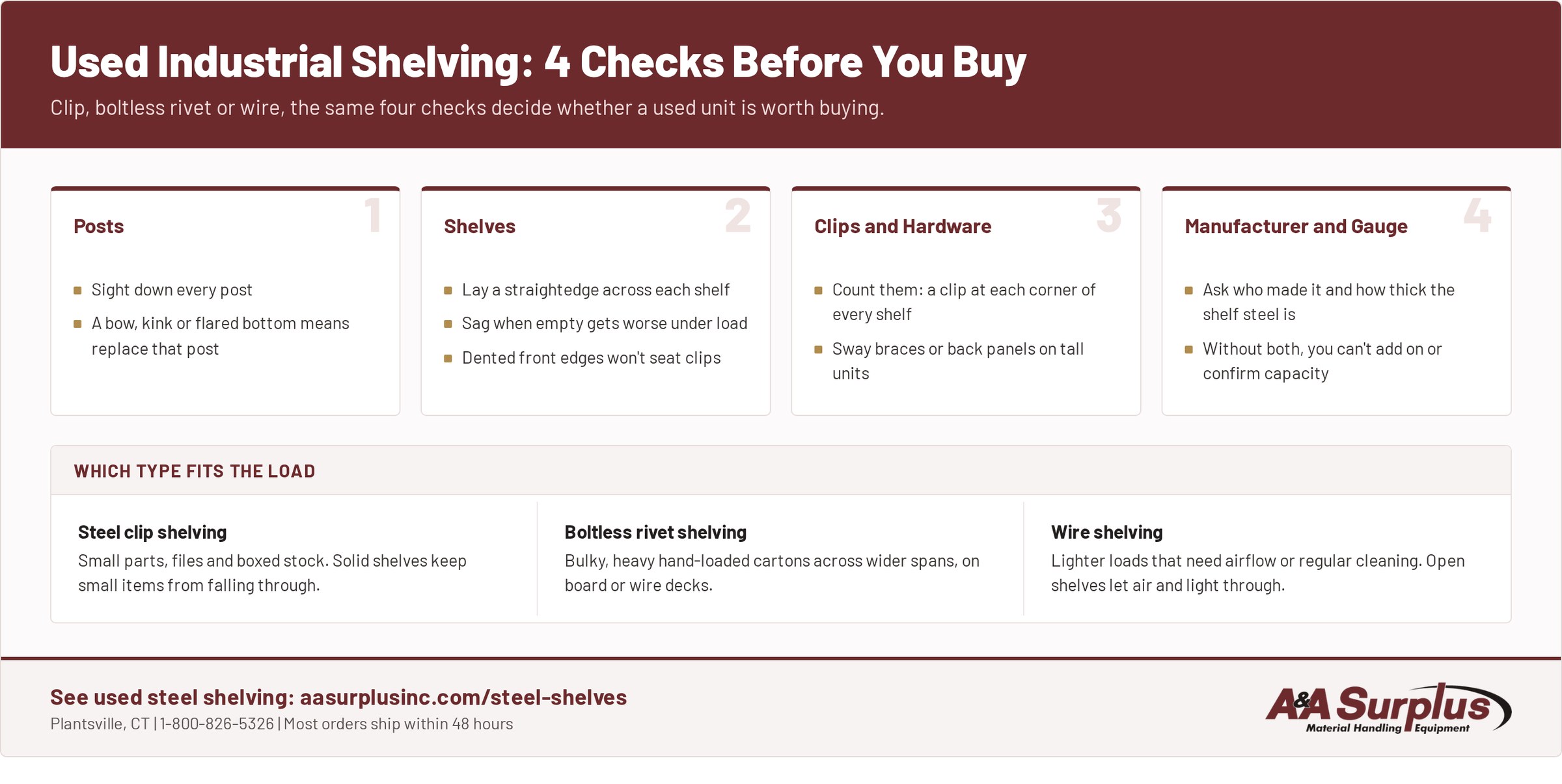
Check four things on any used shelving, from any seller: the posts, the shelves, the hardware, and who made it. Shelving doesn’t wear out from holding boxes. Damage comes from pallet jacks, carts and careless teardowns, and it’s easy to spot once you know where to look.
- Posts: sight down every post. A bow, a kink or a flared bottom means that post should be replaced, not straightened.
- Shelves: lay a straightedge across each shelf. A shelf that sags when empty will sag more under load, and a dented front edge won’t seat properly.
- Clips and hardware: count them. Clip shelving needs a clip at each corner of every shelf, and tall units need their sway braces or back panels so they don’t lean.
- Manufacturer and gauge: ask who made it and how thick the shelf steel is. Without both, you can’t add on later or confirm what each level is rated to hold.
Light surface rust on a post usually cleans up. Rust that flakes or pits the steel doesn’t. A lot pieced together from several different jobs is worth less than one matched set, even when every piece passes.
Can You Add Used Shelving to Units You Already Own?
Only if it matches the manufacturer, and that catches a lot of buyers. Post hole spacing, clip design and shelf edges vary from one maker to the next, so a shelf from one brand may hang on another brand’s post without actually locking in.
Before you buy add-on units, send three things: a photo of one of your posts with a tape measure next to the holes, the shelf size (depth by width), and the post height. A&A’s team can check those against what’s on the yard. Add-on units share a post with the unit beside them, so a long matched row costs less than the same number of standalone units.
It’s also worth confirming early that shelving is what you need. If product moves by forklift and sits on pallets, you want warehouse racking, not shelving. If people pick by hand, shelving is the right call.
Is Used Industrial Shelving Worth It Over New?
For standard sizes and hand-loaded storage, used warehouse shelving usually wins on cost and speed. Shelving that passes the four checks above holds the same load it was built for.
Speed is often the bigger difference. Most in-stock used shelving at A&A ships within 48 hours. Factory-ordered shelving has to come from the manufacturer, which usually takes longer.
New can still be the better choice. If you need an unusual size, or a large run of identical units with matching finish and paperwork, the used market may not have it in the quantity you need. Stock on the yard changes daily, so a quick call will tell you which way to go.
What Safety Rules Apply to Warehouse Shelving?
Two federal rules matter most for shelving in a warehouse: stored material has to be stable, and it has to stay clear of the sprinklers.
OSHA’s materials storage rule says items stored in tiers must be stacked, blocked, interlocked and limited in height so they’re “stable and secure against sliding or collapse.” On shelving, that means the heaviest items go on the lower levels and nothing hangs over the shelf edge. Tall, narrow units are the ones most likely to tip, so anchoring them to the floor or wall, or tying back-to-back rows together, is worth doing.
OSHA’s sprinkler system standard sets a minimum vertical clearance of 18 inches between sprinklers and the material below. Measure from the sprinkler heads down before you order tall posts for a space with a low ceiling.
What Else Do You Need With Shelving?
Shelving is often only part of the order. Bins, workbenches and lockable storage usually go in at the same time, and buying them together means one delivery instead of several.
Small parts need containers or they end up in a pile. Plastic and steel totes and bins sized to the shelf depth keep fasteners and fittings sorted and labeled. For loose or oddly shaped items, wire baskets let you see what’s inside without pulling them down.
Industrial workbenches give your team a work surface near the stock. Tools and high-value spares belong in lockable storage cabinets, and employee lockers give staff a place for personal gear.
How Fast Can You Get Used Shelving in Connecticut?
Most used shelving orders leave the Plantsville yard within 48 hours, and A&A delivers and installs shelving across Connecticut.
Plantsville is in central Connecticut, so New Haven, Bridgeport, Hartford, Waterbury, Stamford, New Britain and Meriden are all within delivery range. If you’re looking for used industrial shelving near me in CT, you can see the units before they’re loaded. Call ahead so the right lot is pulled. The Connecticut shelving page has more on delivery across the state.
If you’d rather not assemble it yourself, A&A offers professional installation. And if you’re replacing old shelving that’s still in decent shape, A&A is one of the used equipment buyers that may make an offer on it.
Frequently Asked Questions
Is used industrial shelving safe to buy?
Yes, when the posts are straight, the shelves are flat, no hardware is missing and you know who made it. Skip any unit with bent posts, sagging shelves or missing parts you can’t replace.
What’s the difference between clip shelving and boltless shelving?
Clip shelving uses solid steel shelves held up by clips at each corner, which suits small parts and boxed stock. Boltless rivet shelving uses beams that lock into the posts with board or wire decks on top, which suits bulkier, heavier cartons across wider spans.
Can I add used shelving to the units I already have?
Usually only if it’s from the same manufacturer, since post hole spacing and clip design vary between brands. Send a photo of a post with a tape measure beside it, plus your shelf size and post height, and A&A can check for a match.
Where can I find used shelving for sale near me in Connecticut?
A&A Surplus is at 389 Marion Ave, Plantsville, CT 06479. Most shelving orders ship within 48 hours. Call 1-800-826-5326 first so the units are pulled and ready to look at.
Does A&A buy used shelving?
A&A buys used material handling equipment. Call 1-800-826-5326 to ask about the shelving you have.
Tell Us What You’re Storing
Send your space dimensions, what goes on the shelves and roughly how heavy it is. If you’re adding to existing shelving, include a photo of a post with a tape measure beside it. Someone will tell you what’s on the yard, whether it fits and when it can be delivered.
389 Marion Ave, Plantsville, CT 06479. Call 1-800-826-5326.
Clip, Rivet and Wire Shelving
Quotes Built Around Your Space
Ships in 48 Hours From Plantsville, CT
Ready To Shelve Your Space?
Get the shelving you need now from A&A Surplus Inc., BBB Accredited with an A+ rating.
Or call us directly: 1-800-826-5326 | Mon-Fri 7:30 a.m. – 4 p.m.