

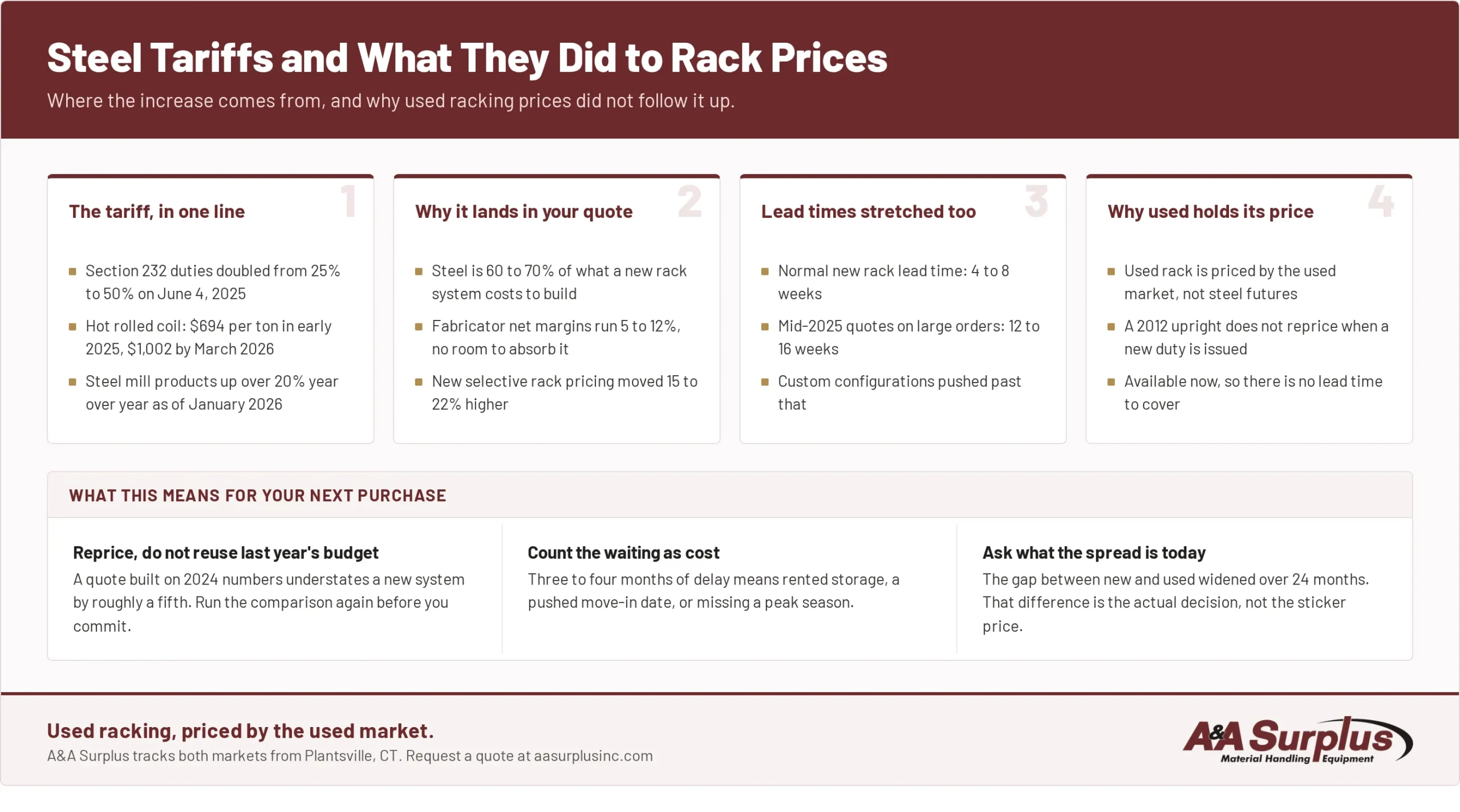
Steel tariffs have pushed new warehouse equipment prices 15 to 22% higher, which is why more buyers are pricing used racking this year. Section 232 duties doubled from 25% to 50% in June 2025, and hot rolled coil reached $1,002 per ton by March 2026 against $694 at the start of 2025. Steel is 60 to 70% of what a new rack system costs to build, so that increase lands in your quote. A&A Surplus tracks both markets from Plantsville, CT. Here’s what the numbers mean for your next purchase.
Most warehouse managers haven’t run the updated numbers. And honestly, that’s understandable, because tariff policy doesn’t feel like something that lands on your loading dock. But it does.
On June 4, 2025, Section 232 steel tariffs doubled. What was a 25% import duty became 50%, with limited exceptions. Hot rolled coil steel, the raw material that goes into virtually every pallet rack, beam, and upright in a warehouse, hit $967 per ton by early April 2025, softened mid-year, then climbed back to $1,002 per ton by March 2026. That’s up from $694 per ton at the start of 2025.
For anyone buying new racking this year, those numbers matter a lot. For anyone on the fence about used versus new, they may have already settled the argument.
Where The Price Hike Actually Comes From
Steel accounts for 60 to 70% of the manufactured cost of a new pallet rack system. When the raw material cost jumps 40% in a year, that increase doesn’t get absorbed by the manufacturer. It gets passed downstream.
That’s just how supply chains work. Rack fabricators buy steel coil, run it through roll-forming lines, apply powder coat, and ship finished uprights and beams. Their margins are thin. Most are running 5 to 12% net. There’s no buffer to absorb a tariff doubling, so they either raise prices or stop taking orders.
So they raised prices.
Industry pricing for new selective pallet rack moved 15 to 22% higher between early 2024 and mid-2025, depending on the gauge and configuration. Some higher-spec systems with thicker column profiles saw larger increases. This isn’t speculation: steel mill products were up over 20% year-over-year as of January 2026, per Federal Reserve Beige Book reporting.
The Lead Time Problem Compounds This
Price isn’t the only variable that shifted. Timing did too.
When tariffs create cost uncertainty, procurement managers at manufacturing companies do what procurement managers do: they pull orders forward and try to lock in pricing before the next escalation. That behavior drives backlogs. And in 2025, combined with underlying demand from e-commerce buildouts and reshoring investments, new rack lead times stretched.
Standard new pallet rack runs 4 to 8 weeks under normal conditions. By mid-2025, several major fabricators were quoting 12 to 16 weeks for large orders. Custom configurations (double-deep, drive-in, specific colors or gauge specs) pushed past that.
That’s three to four months of waiting before a single pallet goes on a beam. For a company opening a new facility, relocating operations, or trying to add capacity before a peak season, that window is genuinely costly. You’re either renting temporary storage, delaying your move-in date, or both.
The used market doesn’t have a lead time problem.
Used Racking As A Tariff Hedge: The Math Most People Skip
Here’s the thing most buyers haven’t worked through: used pallet rack pricing is set by the used equipment market, not by steel futures or tariff schedules.
A used teardrop upright sitting in a dealer’s yard was fabricated in 2018 or 2012 or 2009. Its market price reflects what buyers are willing to pay for that specific piece of steel, in that condition, available now. It doesn’t reprice every time USTR issues a new proclamation.
So while new rack climbed 15 to 20% over 24 months, used rack prices stayed far more stable. The spread that’s opened between new and used is real. Used racking is consistently 40 to 60% cheaper than new on a per-bay basis under normal conditions. In the current tariff environment, that discount has widened another 20 to 30 percentage points relative to what it was two years ago.
Run the comparison yourself on a modest 10,000 square foot expansion:
- New selective rack for 500 pallet positions: roughly $35,000 to $45,000 at 2026 pricing, before freight and installation.
- Used equivalent from a dealer with clean, inspected inventory: $14,000 to $20,000 installed.
That gap has grown. It wasn’t this wide in 2023.
One more thing worth running: the cost of waiting. If a facility opening slips eight weeks because new rack didn’t arrive, what does that cost in rent, labor holding patterns, or delayed revenue? For most operations, it’s not a trivial number. Used rack that’s available in a week doesn’t just save money on the purchase price, it saves money on the calendar.
What “Used” Actually Means When You Buy From A Dealer Like A&A Surplus
There’s a version of “used pallet rack” that means “we pulled this out of a closing grocery distribution center and it’s been sitting on a muddy lot for six months.” That version has real risks. Load capacity unknowns, column damage that’s been touched up with a rattle can, base plates that are bent enough to affect plumb. It happens.
Then there’s what A&A Surplus carries.
A and A Surplus buys used material handling equipment from industrial operations, warehouses, and facility liquidations throughout the Northeast. Before anything goes into inventory or out the door, it gets inspected. Bent columns, cracked welds, damaged base plates: those get sorted out. What’s available to buyers is structural steel that’s been assessed, not just catalogued and moved.
That matters because pallet rack is load-bearing infrastructure. A cracked upright under 2,000 pounds of product doesn’t telegraph failure ahead of time. The inspection step isn’t bureaucratic, it’s the difference between a rack system and a liability.
AA Surplus has been doing this long enough, over 85 years in the material handling business, to know what to look for. And to know what not to sell.
| Factor | New selective rack | Used selective rack |
|---|---|---|
| Exposure to steel pricing | Direct, steel is 60 to 70% of build cost | None, the steel was bought years ago |
| Price movement since early 2024 | Up 15 to 22% | Broadly stable |
| Lead time | 4 to 8 weeks normally, 12 to 16 on larger orders | Ships from stock, often the same week |
| 500 pallet positions | Roughly $35,000 to $45,000 before freight and install | Roughly $14,000 to $20,000 installed |
| Tariff risk on the next order | Repriced whenever the mill reprices | Set by the used equipment market |
| Best fit | Specialty profiles, seismic specs, flexible timeline | Standard teardrop, budget pressure, hard deadline |
The Right Question To Ask Your Procurement Team Right Now
If you’re planning a warehouse expansion, reconfiguration, or new facility fit-out in 2026, the question isn’t “should we look at used?” The question is whether your team has actually priced both options side by side with current market data.
Most haven’t. The assumption that new rack is the standard and used is the fallback is baked into a lot of procurement processes that haven’t been revisited since 2020 or 2021, when supply chain chaos made buying anything used feel risky. That was a reasonable instinct then. Lead times on used equipment were long too because availability was tight. The market has changed. The math has changed with it.
There’s also a compatibility question that sometimes stops buyers short before they’ve done the math: “will used rack from multiple sources actually work together?” Mostly, yes. Teardrop-style uprights from major manufacturers (Interlake, Unarco, Ridg-U-Rak, Penco) use compatible beam connectors. A good dealer can tell you what’s compatible with what you have. It’s not a guessing game if you’re working with someone who knows the product.
Used inventory from A&A Surplus ships fast. Standard lead times are days or weeks, not months. For buyers working against a facility opening date or a lease start, that speed has real dollar value. Time is money in a construction schedule.
Frequently asked questions
How much have steel tariffs raised warehouse racking prices?
New pallet rack pricing moved 15 to 22 percent higher between early 2024 and mid-2025. Section 232 duties doubled from 25 to 50 percent on June 4, 2025, and hot rolled coil reached $1,002 per ton by March 2026 against $694 at the start of 2025. Steel is 60 to 70 percent of a new rack’s build cost.
Do steel tariffs affect used pallet racking prices?
Not directly. Used rack pricing is set by the used equipment market, not by steel futures or tariff schedules. A used teardrop upright was fabricated years before the current duties existed, so its price reflects condition and availability rather than this week’s mill quote.
What are lead times on new pallet racking in 2026?
Four to eight weeks under normal conditions, with several major fabricators quoting 12 to 16 weeks on large orders. Custom work such as double-deep, drive-in, or non-standard gauge pushes past that. Used racking ships from existing inventory instead, frequently within the week.
Is used racking cheaper enough to justify the switch?
Used runs 40 to 60 percent below new per bay under normal conditions, and the current tariff environment has widened that gap. Add the cost of waiting: rent, idle labor, and delayed revenue during a 12 week lead time usually exceed whatever a new order saves in warranty value.
One Thing This Post Isn’t Going To Tell You
What the right mix is for your specific operation.
That depends on your layout, your load requirements, your fire code situation, whether you need new accessories for custom beam configurations, and frankly how much of your system is already used versus new and what you’re trying to match. There’s no formula that spits out the answer for every facility.
What A&A Surplus can do is walk through your requirements with you, and if used inventory makes sense, show you what’s available. If it doesn’t, they’ll say so.
Browse the pallet rack inventory, or if you have equipment to move in the process of reconfiguring your facility, see how the equipment purchasing program works. For fit-out and installation questions, the services page covers what’s available.
The tariff environment isn’t going to get simpler in 2026. Getting the math right on the front end is worth the time.
Sources: Section 232 tariff rates and timeline, U.S. Customs and Border Protection; steel price data, CRU Hot Rolled Coil Index via CME Group, Steel Warehouse Market Update March 2026; manufacturing cost impact, Federal Reserve Beige Book, April 2026.
Save 30-50% vs. New Equipment
Quotes Built Around Your Space
Ships Same Week From Plantsville, CT
Ready To Upgrade Your Warehouse?
Stop waiting on extended manufacturer lead times. Get the storage capacity you need right now from A&A Surplus Inc. – in business since 1939, BBB Accredited, A+ Rating.
Or call us directly: 1-800-826-5326 | Mon-Fri 7:30 a.m. – 4 p.m.