


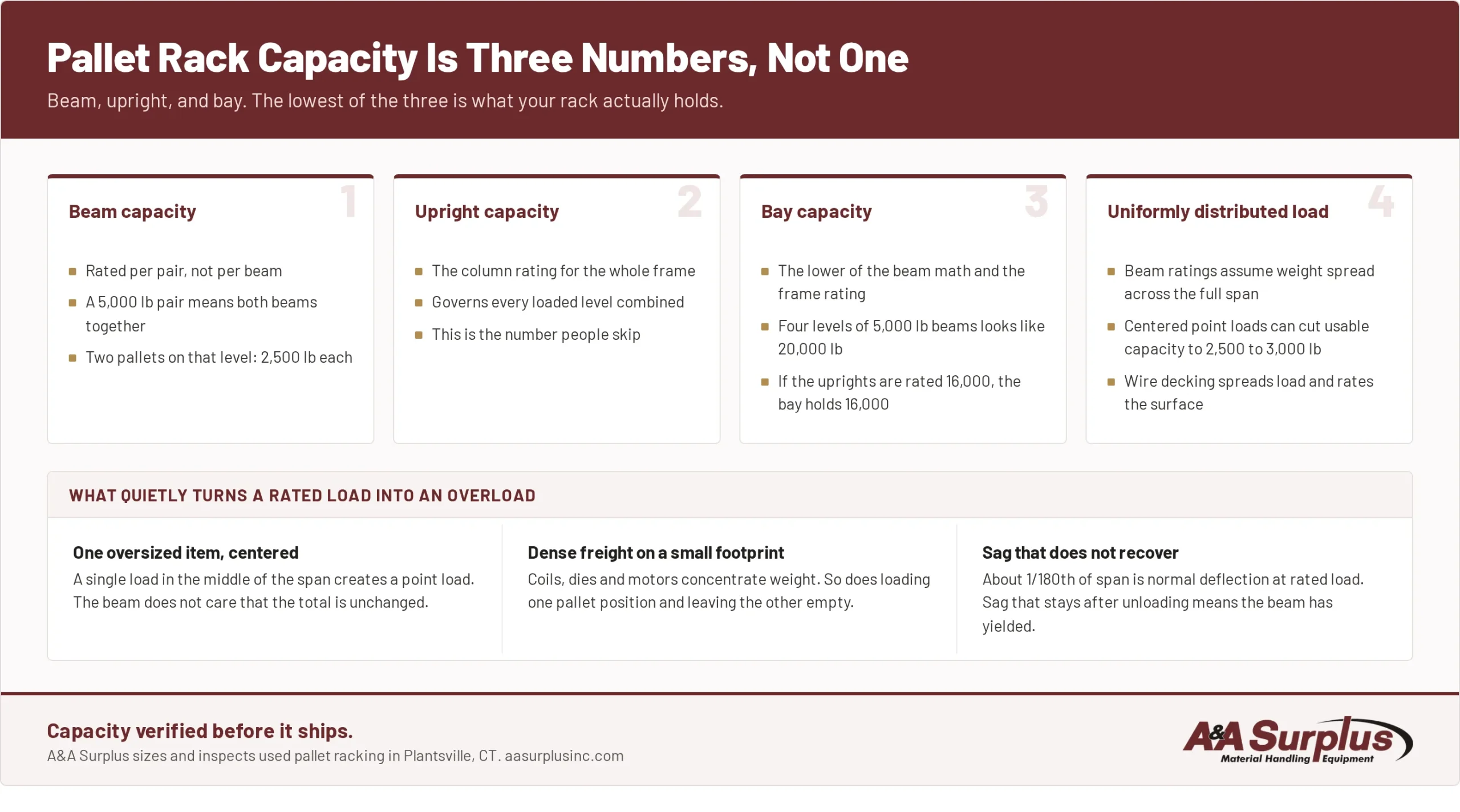
Pallet rack weight capacity isn’t one number, it’s three: beam capacity, upright capacity, and bay capacity, and the lowest of the three is what your rack actually holds. A beam pair rated at 5,000 pounds carries that load across both beams on the level, not per beam, and the upright rating caps everything stacked in the frame. A&A Surplus sizes and inspects used pallet racking out of Plantsville, CT, and these are the first numbers our team checks. Here’s how to run them before you fill a bay.
A beam rated for 5,000 pounds is not a beam that holds 5,000 pounds.
That sentence trips up more warehouse managers than any other part of rack engineering, and it’s the reason capacity questions keep landing on our phones. Somebody read a number off a spec sheet, loaded to that number, and watched a beam bow in the middle. Nothing fell, but the deflection was visible from the aisle, and now there’s a safety meeting on the calendar and a purchasing manager asking whether the rack was ever any good.
The Three Numbers You Actually Need
Every rack system has a beam capacity, an upright capacity, and a bay capacity. Most spec sheets lead with the first one, since it’s the biggest and the easiest to print.
Beam capacity is rated per pair, not per beam. A pair rated at 5,000 pounds means both beams in that level, together, carry 5,000 pounds. Load two pallets on that level and you’ve got 2,500 pounds of usable capacity each.
Upright capacity is the column rating for the frame, and it governs the total weight stacked on that frame from every beam level combined, which makes it the number that decides whether a bay is safe once you’ve filled all four or five levels rather than just the one you were looking at.
This is the number people skip.
Bay capacity is what you get when you check the first two against each other and take the lower answer. A bay with four levels of 5,000-pound beams looks like 20,000 pounds of storage. If the uprights are rated for 16,000, your bay holds 16,000. The beams aren’t the constraint. The frame is.
So the math is less about calculation and more about finding your weakest link. Add up what you want to store per bay, divide by levels, then confirm both the beam pairs and the frame can take it.
Why Uniformly Distributed Load Changes Everything
Beam ratings assume UDL, or uniformly distributed load, meaning the weight spreads evenly across the full span rather than piling up anywhere in particular. Two pallets sitting on a pair of beams, roughly centered, roughly equal weight, is a textbook UDL condition.
Concentrate that same weight in the middle of the span and you’ve created a point load. The beam doesn’t care that the total is unchanged. Bending stress at midspan goes up sharply, and a beam rated for 5,000 pounds UDL might handle only 2,500 to 3,000 as a single center load depending on the profile.
Things that quietly turn UDL into point load:
- One oversized item centered on a level instead of two pallets at the uprights
- Coils, dies, or motors on a pallet that concentrate weight in a small footprint
- Loading a level with a single pallet and leaving the other position empty
- Hand-stacked cases sitting directly on the beams with no decking to spread the load
That last one is where wire decking earns its keep, but the deck’s published capacity also assumes a uniformly distributed load supported by both the front and rear beams. A wire deck rated for 2,500 pounds is not necessarily rated for a 2,500-pound direct load that does not bear on both beams. Concentrating the load directly on the deck can cause it to deform or deteriorate over time, even when the total weight is within the stated capacity.
For example, when A&A Surplus requested decking for 2,500-pound pallets that would be applied as direct loads rather than supported by both beams, the manufacturer’s engineers specified 3,500-pound-rated decking. Direct-load applications should therefore be reviewed with the manufacturer instead of relying solely on the deck’s uniformly distributed load rating.
Deflection is the other half of this. Industry practice limits beam sag to roughly 1/180th of the span, so a 96-inch beam can bow about half an inch at full rated load and still be within spec. A little bow isn’t failure. It’s the design working. Persistent sag that doesn’t recover when you unload the level, though, means the beam has yielded and needs replacing.
Frame Capacity Depends On Where Your Beams Sit
Here’s the part almost nobody reads off the spec sheet correctly. Upright capacity isn’t fixed by the frame alone. It’s a function of the longest unsupported vertical distance between beam levels.
Columns fail by buckling, and the longer the unbraced length between beam levels, the less load the column carries, which means the same frame gets stronger when you tighten beam spacing and weaker when you spread it out. Pull the first beam level up high to clear a forklift attachment and you’ve just cut your frame rating, sometimes by thousands of pounds. That’s why beam heights belong in the warehouse layout from day one, set alongside aisle and clearance dimensions instead of after them.
Which means reconfiguring a rack is an engineering change, not a housekeeping task. Teams move beams to fit a new SKU profile all the time and assume the ratings travel with them. They don’t. If you raise a level, recheck the frame capacity against the new spacing before you load it.
| Capacity rating | Beam capacity | Upright (frame) capacity | Bay capacity |
|---|---|---|---|
| What it rates | One pair of beams on a single level | The whole frame, every level combined | The bay as a system |
| How it is published | Per pair, not per beam | Per frame at a stated beam spacing | Not published, you calculate it |
| What changes it | Span length and beam profile | Longest unbraced distance between beam levels | Whichever of the first two is lower |
| What breaks it | Point loading instead of uniform load | Raising a beam level and stretching the spacing | Loading to the beam number and ignoring the frame |
| Typical mistake | Reading 5,000 lb as 5,000 lb per beam | Assuming the rating travels when beams move | Multiplying beam rating by level count |
Buying Used: How Capacity Gets Verified
The fair question about used pallet rack is whether you can trust the numbers on steel that’s already spent fifteen years in somebody else’s building.
You can, if the identification work gets done. Rack capacity is a property of the steel and geometry, not of age. A 3-inch by 3-inch column with a 12-gauge wall carries what it carried in 2009. What changes is condition.
Verification runs on three tracks. First, identify the manufacturer and profile. Punch pattern, column dimensions, gauge, and beam end connector style narrow it down fast, and published load tables do the rest. Second, inspect for damage that reduces capacity: column dents, twisted or missing braces, base plates pulled off anchor, cracked welds at connectors. A dented column is not a rated column, and damage that pushes a column even a quarter inch out of plumb can knock a serious percentage off the rating, which is why condition inspection matters far more on used steel than the year it was rolled. Third, confirm the configuration you’re actually buying, since capacity depends on the beam spacing you plan to run.
Our technical team does this on inbound inventory before it goes out. When published tables don’t exist for an older profile, we’ll tell you that plainly rather than guessing at a number, and in that situation the right move is an engineer’s stamp on the configuration. That’s cheap compared to a collapse.
Labels, OSHA, And What Inspectors Look For
OSHA doesn’t publish a pallet rack standard. There’s no regulation you can point to that sets a required rack rating.
What OSHA does have is 1910.176(b), which requires stored material to be stable and secure, plus the General Duty Clause. Citations for overloaded or damaged racking get written against those, and inspectors lean on the industry standard, ANSI MH16.1 from the Rack Manufacturers Institute, to establish what a reasonable employer should have known.
MH16.1 calls for a permanent load plaque on the rack showing maximum load per level and maximum total load per bay, positioned where an operator can see it. Sometimes new rack ships with plaques. Used rack often doesn’t. The plaque stayed with the original configuration or got scraped off during teardown.
So if you’re buying used, plan on posting your own load signage based on the verified capacity for your configuration. Cheap to do, and awkward to explain in an inspection if you skipped it. * A&A does not provide rack plaques or labeling; customers handle that themselves.
Frequently asked questions
How much weight can a pallet rack hold?
It depends on three ratings, and the lowest one governs. A common selective bay runs beam pairs rated 4,000 to 6,000 pounds per level, with frames rated 16,000 to 30,000 pounds total. Check the beam pair rating, the frame rating at your current beam spacing, then load to the smaller number.
Is beam capacity per beam or per pair?
Per pair. A pair rated at 5,000 pounds carries 5,000 pounds across both beams on that level, not 5,000 each. Two pallets on that level means roughly 2,500 pounds of usable capacity per position, assuming the weight sits evenly across the span.
How do you verify load ratings on used pallet racking?
By identifying the steel, not by guessing. A&A Surplus matches the punch pattern, column profile, gauge, and beam depth to the manufacturer, then applies the published rating for that profile at your beam spacing. Anything bent, cracked, or missing a base plate is pulled before it is priced.
Does moving a beam level change rack capacity?
Yes, and this catches experienced teams. Frame capacity is a function of the longest unsupported distance between beam levels, so raising a level to clear an attachment can cut the frame rating by thousands of pounds. Recheck the frame rating against the new spacing before reloading the bay.
Where People Get It Wrong
The failures we see aren’t math errors.
They’re assumption errors.
Somebody averages pallet weight instead of using the heaviest pallet. Somebody adds a fifth beam level to a frame rated for four. Somebody mixes beams from two manufacturers in the same bay after finding the connectors fit, which puts an unknown rating on a bay nobody will ever recalculate. Somebody loads a repaired column back to its original rating.
Run your numbers off the heaviest load you’ll actually store, not the average. Recheck the frame every time beam spacing changes. Keep your capacity documentation somewhere a new supervisor can find it in a year.
If you’re configuring a system from scratch or trying to work out what an existing one can take, send us your pallet weights and beam sizes, and we’ll match the beams to the load when we quote it.
And if the answer comes back lower than you hoped, take it. The steel doesn’t negotiate.
Save 30-50% vs. New Equipment
Quotes Built Around Your Space
Ships Same Week From Plantsville, CT
Ready To Upgrade Your Warehouse?
Stop waiting on extended manufacturer lead times. Get the storage capacity you need right now from A&A Surplus Inc. – in business since 1939, BBB Accredited, A+ Rating.
Or call us directly: 1-800-826-5326 | Mon-Fri 7:30 a.m. – 4 p.m.