

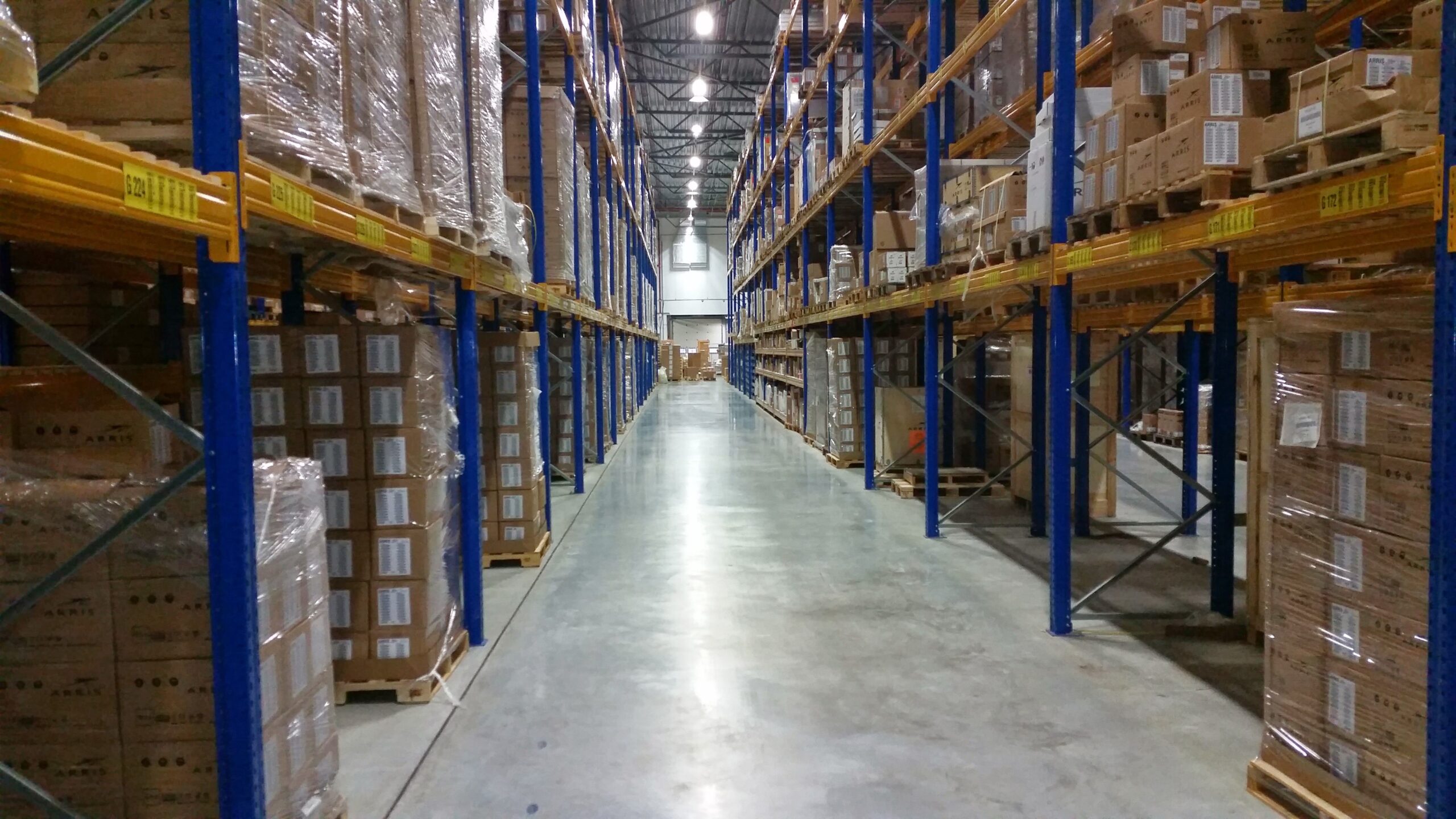
New domestic pallet racking takes about 14 weeks to reach your dock, and in the last equipment crunch that stretched to 18 or 20. Used warehouse equipment cuts the wait to days, because the steel already exists and skips mill lead times, fabrication backlogs, and every order queued ahead of yours. A&A Surplus ships used racking and material handling equipment across the Northeast from Plantsville, CT, often the same week. If a lease or a peak season is closing in, that gap is the whole decision.
Fourteen weeks is a long time to wait for shelves.
That’s roughly the range you’re looking at for new domestic pallet racking when manufacturers are running at capacity, and historically it’s gone worse than that. During the post-pandemic equipment crunch, some lead times for new domestic racking stretched to 18 to 20 weeks. Four to five months from purchase order to first pallet in the air. If you’ve got a lease starting, a contract to fulfill, or a seasonal peak bearing down, that timeline doesn’t work. It just doesn’t.
So let’s talk about what actually does.
Where the wait comes from
It’s not one thing. It’s three things stacking on top of each other.
First, the steel. Flat-rolled steel, the raw material most rack manufacturers use, comes out of the mill on its own schedule. As of early 2026, hot-rolled coil runs about six weeks from order to delivery. Cold-rolled and coated products are closer to seven or eight. That’s before anyone cuts, bends, punches, or powder-coats anything. The mill lead time is just the starting line.
Second is fabrication capacity. When demand spikes, and it does, often without much warning, rack manufacturers can’t just flip a switch. Steel King Industries expanded production capacity by 28% in 2024 specifically to keep up with demand, and they’re one of the larger players. Smaller fabricators don’t have that flexibility. When the order backlog grows, the queue grows with it.
Then there’s freight. Finished rack ships on flatbeds or in LTL quantities, and it’s not light. Freight scheduling, driver availability, and routing add days or weeks depending on where you’re located relative to the plant.
Add it up and you get 10 to 20 weeks on a new rack order, depending on spec, quantity, and who you’re buying from. That’s a real number, not a worst-case scenario.
The cost of waiting that nobody talks about
Here’s what I keep seeing get left out of this conversation: the wait has a price tag.
Not just the equipment price. The cost of the missing capacity itself.
Say you need 5,000 square feet of new storage to handle a product line you just onboarded. While you wait 16 weeks for new racking to arrive, that inventory is sitting somewhere: on the floor, in overflow space you’re renting by the pallet, or in a trailer you’re paying demurrage on. Every week of that gap has a dollar figure attached. Warehouse floor space at $8 to $12 per square foot per year means a 5,000-square-foot gap costs somewhere between $800 and $1,200 per week in lost capacity value, before you even count the operational headaches.
That’s not an abstract loss. It compounds. Product you can’t store is product you can’t ship, and product you can’t ship is revenue you can’t book.
The purchase price difference between new and used racking starts to look pretty irrelevant once you run that math.
Used racking as an availability play
This is where A&A Surplus is different from most options.
A&A Surplus stocks used pallet racking across a 15-acre inventory in the Northeast, and most orders ship within the same week. Not weeks, plural. The week you call. That’s the operational case for used racking right there, and the price is usually better too.
The question isn’t “is used racking as good as new?” It’s “do I need racking in five days or sixteen weeks?” If the answer is five days, the conversation’s over.
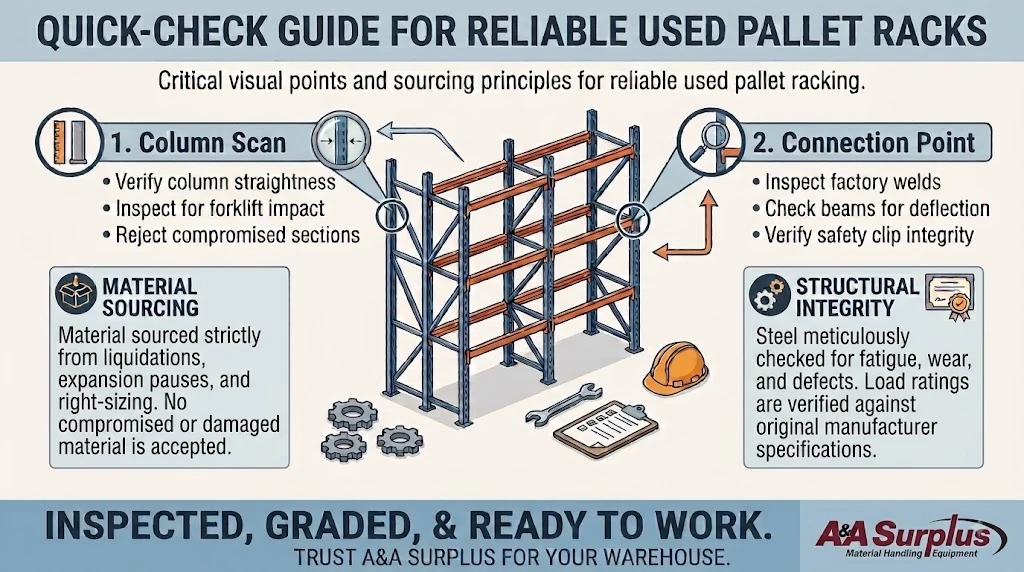
And honestly? The inventory A&A carries isn’t beat-up junk from a burned-out DC. It’s inspected steel from facility liquidations, expansions that got paused, and operations that right-sized their footprint. That material gets evaluated before it goes back out the door. Uprights with damage get pulled. Beams get checked for deflection and connector integrity. What ships is what passed.
For standard pallet rack configurations (selective racking, drive-in, push-back), used is a completely legitimate answer. Most of the used rack in circulation was manufactured by the same handful of companies making new rack today: Interlake, Ridg-U-Rak, Unarco, Frazier. The steel doesn’t stop being good steel just because it’s had a first owner.
What “inspected” actually means
Let me be direct about this, because it’s where people get nervous.
Used racking from a reputable dealer isn’t the same as rack you pull out of a random warehouse auction and bolt up yourself. The difference is inspection and grading. At A&A Surplus, material goes through a physical check before it’s priced and listed. Bent columns, cracked welds, compromised safety clips. That stuff doesn’t make it out the door.
There’s also the load rating question. Most used rack carries its original capacity ratings because the steel itself hasn’t changed. A 3-inch step beam rated at 4,200 pounds per pair in 2012 is still rated at 4,200 pounds per pair today, assuming no structural damage. OSHA and the Rack Manufacturers Institute (RMI) both have guidance on rack inspection; a good used rack dealer operates with those standards in mind.
The practical takeaway: used doesn’t mean unsafe. It means second-hand. Those aren’t the same thing.
Cantilever rack in particular holds up well as used inventory because it doesn’t take the forklift impact that selective racking does. Uprights stay straighter. Arms see less wear. It’s a category where “used” is almost a non-issue from a structural standpoint.
When new actually makes sense
I’m not going to pretend used is always the right call.
There are situations where new racking is the correct answer. If you’re running a very specialized configuration (narrow-aisle deep-lane systems, high-density mobile racking, or anything with a custom column spacing that doesn’t match standard used inventory), used may simply not be available in the spec you need. You’d be mixing profiles from different manufacturers and asking your installers to make it work, which is a headache nobody needs.
Warranty requirements are another one. Some lease agreements or corporate procurement policies require new equipment with manufacturer warranties. That’s a real constraint, not a preference. If your compliance team needs a warranty in the file, used isn’t going to satisfy that requirement regardless of condition.
And if your timeline is flexible, say you’re planning a facility expansion six months out and you want a specific color, a specific beam step, and documented load ratings from the OEM, new makes sense. You have time. Use it.
But if you’re in the situation most people call about, which is “I need racking in the next two to three weeks and I can’t wait,” the used market deserves a serious look before you put in a new order and settle in for the wait.
| Decision factor | New racking | Used racking | Mixed new and used |
|---|---|---|---|
| Typical lead time | 14-20 weeks | Same week from stock | 2-3 weeks |
| Cost vs. new | Baseline | 30-50% less | Roughly 20-30% less |
| Configuration control | Exact spec, any color | What is in inventory now | New for the odd bays, used for the rest |
| Load ratings | OEM documented | Original ratings, verified on inspection | Mixed, documented per section |
| Manufacturer warranty | Yes | No | On the new components only |
| Best fit | Flexible timeline, specialized or narrow-aisle systems | Lease start, peak season, contract deadline | Phased expansion with one urgent zone |
Frequently asked questions
How long does used pallet racking take to ship?
Most used racking at A&A Surplus ships the same week you order it, because the steel is already sitting in the 15-acre inventory in Plantsville, CT. There is no mill lead time, no fabrication queue, and no production slot to wait for. New domestic racking runs 14 to 20 weeks by comparison.
Is used pallet racking safe to use?
Yes, when it is inspected and graded before resale. Used rack carries its original load ratings as long as the steel is undamaged, so a beam rated at 4,200 pounds per pair when it was built still carries that rating today. A&A Surplus pulls bent columns, cracked welds, and compromised safety clips before anything is priced, working to OSHA and Rack Manufacturers Institute inspection guidance.
How much cheaper is used racking than new?
Expect 30 to 50 percent below the cost of comparable new racking. The larger saving is usually the capacity you stop losing while you wait: a 5,000-square-foot storage gap costs roughly $800 to $1,200 a week in lost floor value, which adds up fast across a 16-week lead time.
When should I buy new racking instead of used?
Buy new when your configuration is specialized, such as narrow-aisle deep-lane or high-density mobile systems, when procurement or a lease requires a manufacturer warranty on file, or when your timeline is genuinely flexible and you want a specific color, beam step, and OEM documentation.
What to do right now
If you’re running a timeline that new rack won’t solve, A&A Surplus’s in-stock rack inventory and services are worth a call or a visit. Same-week shipping from in-stock inventory is the actual differentiator here. There’s no ordering lead time, no freight scheduling window to negotiate, no fabrication queue to sit in.
Tell them your bay dimensions, your load requirements, and your drop-dead date. They’ll tell you what’s available and what ships when.
That’s a pretty short conversation compared to calling a new rack manufacturer and being told your order will land sometime in September.
Save 30-50% vs. New Equipment
Quotes Built Around Your Space
Ships Same Week From Plantsville, CT
Ready To Upgrade Your Warehouse?
Stop waiting on extended manufacturer lead times. Get the storage capacity you need right now from A&A Surplus Inc. – in business since 1939, BBB Accredited, A+ Rating.
Or call us directly: 1-800-826-5326 | Mon-Fri 7:30 a.m. – 4 p.m.