

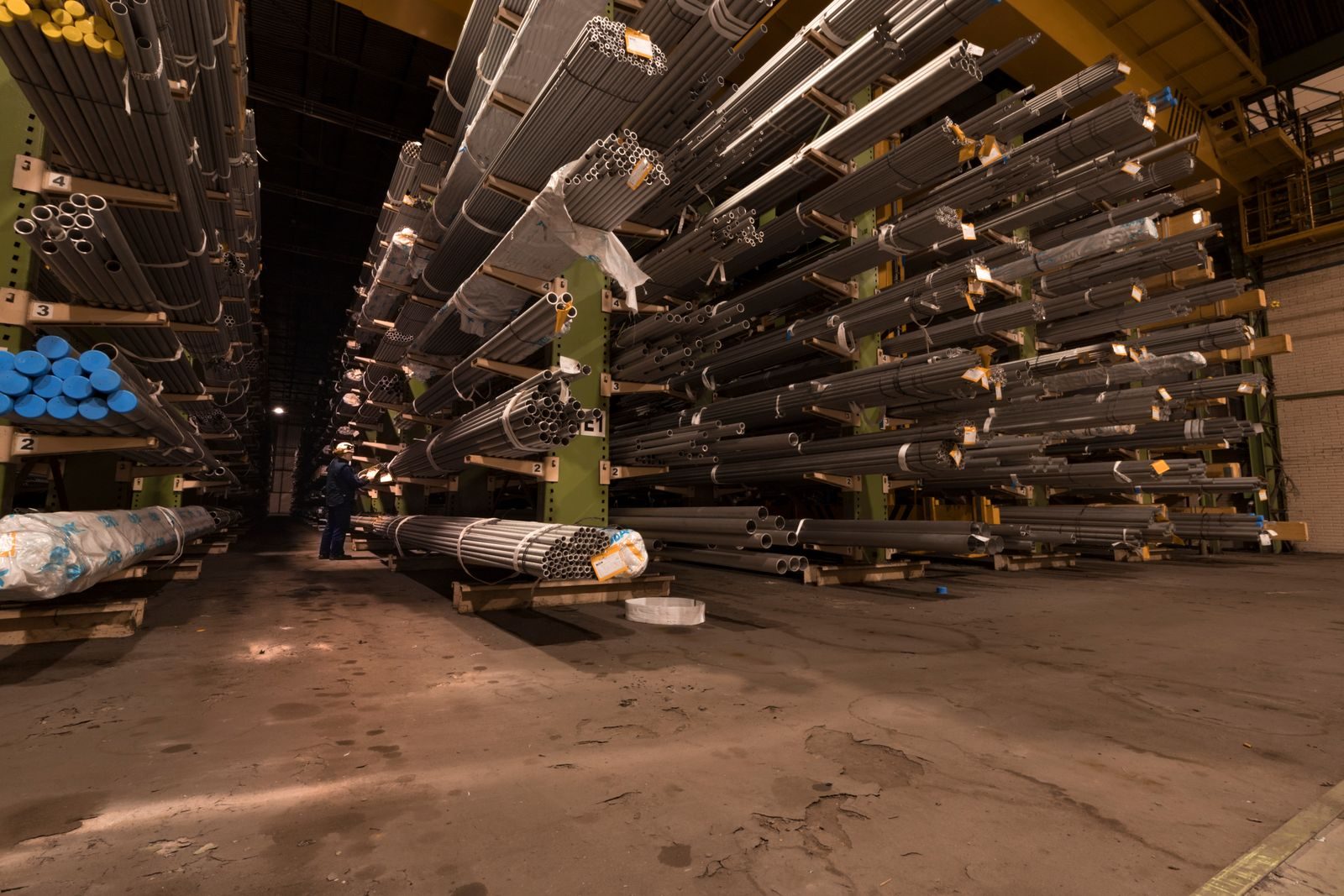
Cantilever racking holds long, awkward loads like pipe, lumber, and steel tube that pallet rack can’t support, using arms that extend from a vertical column with no front post blocking the load. Choosing a system comes down to three calls: load rating per arm, arm length and spacing for your product, and structural versus roll-formed construction. A&A Surplus stocks structural cantilever in Plantsville, CT and sizes systems to real load numbers. Get those three wrong and you pay for capacity you never touch.
Pallet rack can’t hold a 24-foot length of steel tube. Try it and the load either sags between the beams or rolls off the front. That gap is the entire reason cantilever racking exists, and it’s also the reason most people buy the wrong configuration the first time around.
Here’s the deal. Cantilever is the one storage system built from the ground up for long, awkward loads. Arms stick straight out from a vertical column. No front post in the way. You drive up, you load it, you walk away. Simple in theory.
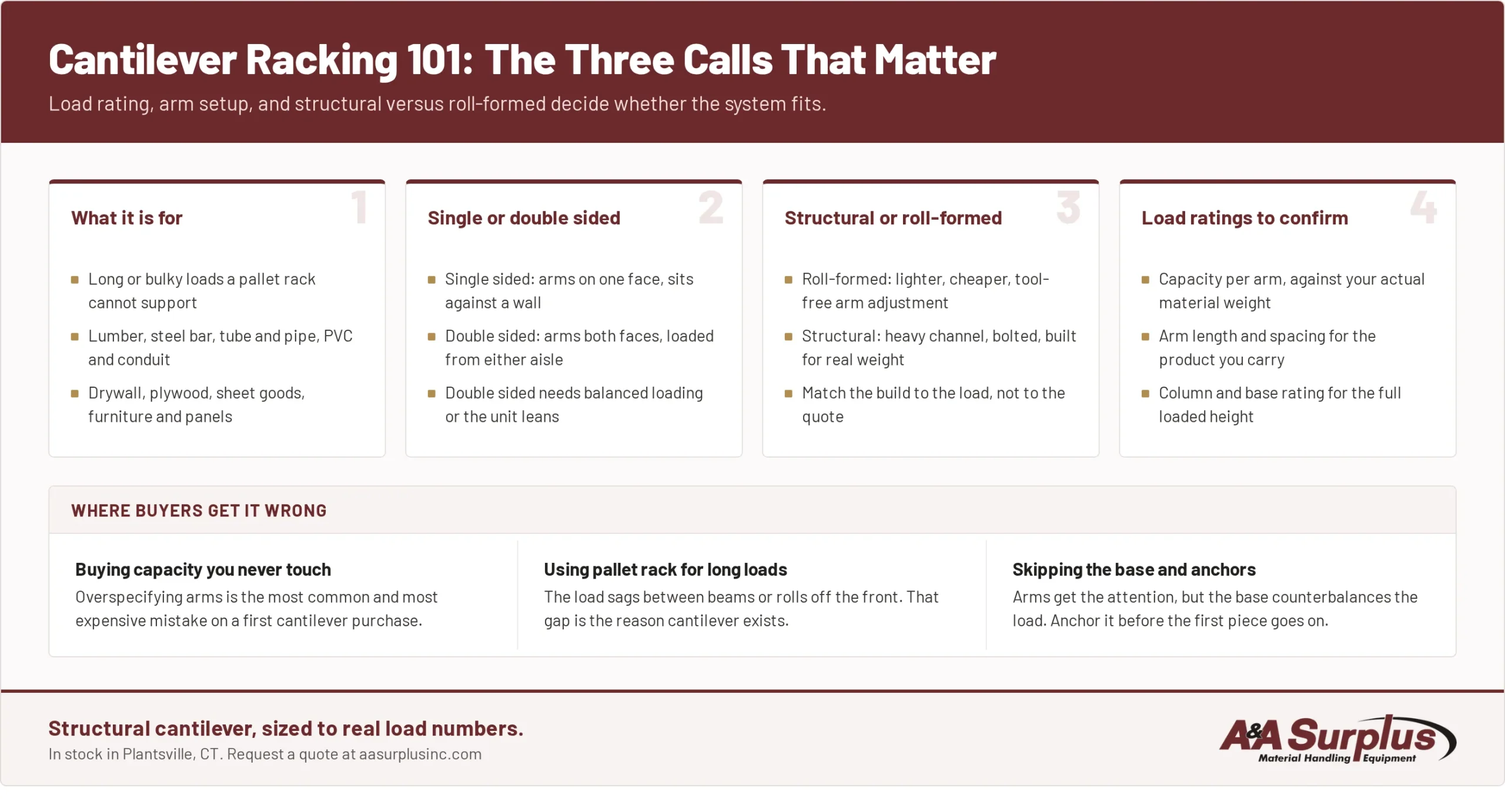
In practice, buyers get tripped up on three things every single time. Load rating. Arm setup. Structural versus roll-formed. Get those wrong and you’ve either overspent on capacity you’ll never touch or, worse, you’ve built something that’s going to fail under a load it should’ve handled. We’ve watched both happen.
What Cantilever Is, And What It Absolutely Isn’T
A cantilever rack is a vertical column, a base that anchors it to the floor, and a set of horizontal arms. The arms carry the load. That’s the whole idea. Because there’s no front column boxing in each storage level, you can slide a 40-foot pipe across four or five arms and it just sits there, fully supported, nothing in the way.
What it isn’t: a pallet rack. People conflate the two constantly. Pallet rack is built for uniform, boxed-up loads sitting on standardized pallets, stacked into bays with upright frames on both sides. The second you try to store something that overhangs a pallet by ten feet, pallet rack quits on you.
Cantilever shines on the stuff pallet rack chokes on:
- Lumber and dimensional timber
- Steel bar, tube, and pipe
- PVC and conduit
- Furniture, mattresses, and oversized panels
- Drywall, plywood, and sheet goods
Notice the pattern. Long, or bulky, or both. If your inventory fits neatly on a pallet, you don’t need cantilever and you shouldn’t pay for it. If it doesn’t, nothing else really works.
Single-Sided Or Double-Sided
This decision comes down to one question: where’s the rack going to live?
Single-sided cantilever has arms on one face only. The column leans back slightly, the base extends forward to counterbalance the load, and you push the whole unit against a wall. It’s the move for perimeter storage, narrow shops, or anywhere you’ve only got access from one direction.
Double-sided puts arms on both faces of a shared column. You set it in the middle of the floor and load it from either side, which roughly doubles your storage on the same footprint. Lumber yards and steel service centers run rows of double-sided cantilever down the center of the building and feed both aisles off one structure. If you’ve got the floor space and you need volume, double-sided is almost always the better dollar-per-foot play.
One thing people forget. A double-sided rack needs balanced loading, or close to it. Pile everything on one side and you’re fighting the physics that keep the unit standing. Most operations manage this fine. Some don’t, and you can usually spot their racks by the lean.
Structural Versus Roll-Formed, And Why The Distinction Matters
This is where the real money decision lives, and it’s the part buyers understand least.
Roll-formed cantilever is made from sheet steel bent into shape on a roll-forming line. It’s lighter, it costs less, and arm heights adjust on a punched-hole pattern without tools. For lighter and medium loads, retail backrooms, and operations where you’re constantly moving arm levels around, roll-formed does the job and saves you cash.
Structural cantilever is built from hot-rolled steel I-beams and channel, the same family of steel that holds up buildings. It’s heavier, it bolts together, and it shrugs off abuse that would dent or deform roll-formed. Steel service centers storing bundles of bar stock that weigh thousands of pounds per arm? They run structural, full stop. Forklift dings, seismic zones, brutal load cycling. Structural takes it.
The trade-off isn’t subtle:
- Roll-formed: lower cost, lighter, fast arm adjustment, lower capacity ceiling
- Structural: higher capacity, takes impact, harder to reconfigure, costs more
A lot of guides tell you to just buy structural and be done with it. That’s lazy advice. Plenty of furniture warehouses and distributors run roll-formed for decades without a single problem because their loads never come close to the ceiling. Buy for the load you actually have, not the load you’re scared of.
Load Ratings: The Three Numbers That Actually Matter
Almost every cantilever failure I’ve heard about traces back to one mistake. Somebody read the arm capacity, saw a big number, and assumed the whole system could handle it. Doesn’t work that way. A cantilever rack has three separate ratings, and the lowest one wins.
Arm capacity is the load a single arm carries at a stated distance from the column. Critical detail: that number drops as the load moves toward the arm tip. A 2,000-pound arm rated at the base might only handle 1,400 near the end. Longer lever, less capacity. Physics doesn’t negotiate.
Column capacity is the total weight one column carries across all its arms stacked together. You can have arms rated for 2,000 pounds each, but if you load six of them and blow past the column rating, the column is the thing that buckles.
Base capacity is what anchors everything and stops the rack from tipping. The base has to counterbalance the forward moment of every loaded arm. Underrate the base and the whole unit pitches forward, which is exactly as bad as it sounds.
Rate all three for your heaviest realistic load, then leave headroom. The arm number alone tells you almost nothing on its own.
| Factor | Structural cantilever | Roll-formed cantilever |
|---|---|---|
| Material | Hot rolled I-beam and channel | Sheet steel bent on a roll-forming line |
| Connections | Bolted | Punched-hole pattern, clip style |
| Arm adjustment | Slower, bolts come out | Fast, no tools |
| Damage tolerance | Shrugs off forklift contact | Dents and deforms more easily |
| Typical use | Steel service centers, bar stock, heavy pipe, seismic zones | Lighter and medium loads, retail backrooms, frequent reconfiguration |
| Cost | Higher | Lower |
Who Actually Runs Cantilever
Walk into any lumber yard and you’ll see it. Rows of cantilever holding dimensional lumber, treated posts, trim, sorted by length and species so a yard hand can pull an order without moving six other bundles first. A cantilever rack for lumber is the default storage answer in that business, and has been for decades.
Steel service centers lean on it harder than anyone. Bar, tube, angle, channel, all of it long and heavy, all of it stored on structural cantilever built to eat the weight. A cantilever rack for pipe and tube is its own subcategory, often paired with end stops or pipe-stop arms so round stock doesn’t roll off.
Then there’s furniture and bedding distributors, who use cantilever for the opposite reason. Their loads aren’t heavy, they’re awkward. Long, wide, easily dinged. Roll-formed cantilever with full-coverage decking handles oversized boxes that would hang off a standard pallet rack and get crushed.
Plumbing suppliers, plastics distributors, glass and window shops. Same story everywhere. The common thread is geometry, not weight. When the load is long, cantilever is the answer.
New Cantilever Racks: Where A&A Surplus Comes In
Ordering direct from a manufacturer, a full structural system can run you tens of thousands with a six-month wait behind it. That’s not how we do it.
This is the part we actually care about. A&A Surplus carries deep cantilever inventory across 15 acres of yard, structural and roll-formed both, columns, arms, bases, and add-on sections, all new, all in stock. Most standard configurations ship within 48 hours instead of sitting in someone else’s production queue for six months.
A few things worth knowing before you order. Match the manufacturer and series where you can, because arm and column connections aren’t universal across brands. Check the arm and column ratings against your real loads, not the catalog ideal. And bring us your dimensions. We’ve laid out enough of these to flag a problem before it ships.
If you want to compare the systems side by side, our cantilever rack systems page lists current inventory, and our pallet rack page covers the standardized-load alternative if you’re genuinely between the two. Not sure what fits? Send us what you’re storing and we’ll quote the towers, arms and bases to match.
One caveat I’ll leave you with. A mismatched component or an underrated base turns a good system into a liability fast. So measure twice, ask questions, and lean on whoever’s speccing it for you. That’s what we’re here for.
Frequently Asked Questions
What is the difference between structural and roll-formed cantilever rack?
Structural cantilever racks use heavy-gauge C-channel steel and are built for the highest loads and outdoor exposure. Roll-formed racks are lighter, lower cost, and work well for indoor storage with lighter materials. A&A Surplus stocks structural systems.
How do I know how many arms I need?
A general rule: one arm per 4 feet of material length. For 16-foot lumber, use four arms — one every four feet. Call 1-800-826-5326 and we’ll help you size it correctly before you order.
Do you offer cantilever rack installation services?
Yes. A&A Surplus provides installation in Connecticut and throughout the Northeast. Our crew handles teardown of existing systems and full setup of new configurations. If you’re outside our primary service area, call 1-800-826-5326 and we’ll let you know what’s available for your location.
How fast does cantilever rack ship?
Most cantilever rack orders ship within 48 hours from our Plantsville, CT facility. We stock towers, arms, bases, and brace sets, so standard configurations are typically ready to go without a wait. Call ahead on large orders and we’ll confirm availability and schedule your shipment.
Can I buy individual components instead of a full system?
Yes. We sell towers, arms, bases, and brace sets individually. This works well if you’re adding capacity to an existing cantilever system or replacing damaged components. Use the configurator above to build exactly what you need, or call us and we’ll pull the right parts from stock.
Do you buy used cantilever rack?
Yes. If you’re closing a facility, relocating, or clearing out inventory, we purchase used cantilever rack systems. We travel nationwide and handle the teardown crew and removal. Call 1-800-826-5326 or visit our We Purchase Used Equipment page to get the process started.
Ready To Upgrade Your Warehouse?
Stop waiting on extended manufacturer lead times. Get the storage capacity you need right now from A&A Surplus Inc. – in business since 1939, BBB Accredited, A+ Rating.
Or call us directly: 1-800-826-5326 | Mon-Fri 7:30 a.m. – 4 p.m.