


Installing warehouse racking comes down to five jobs done in order: confirm the floor and permits, draw a layout around your forklift’s aisle width, set and brace the uprights, lock in beams at rated heights, then anchor and level every column. Skip one and the rack’s rated capacity stops meaning anything. This pallet racking installation guide walks through each step, the mistakes that fail inspections, and when a crew makes more sense than doing it yourself, from a used racking dealer that has installed and relocated systems across the Northeast since 1939.
What Do You Need Before Installing Warehouse Racking?
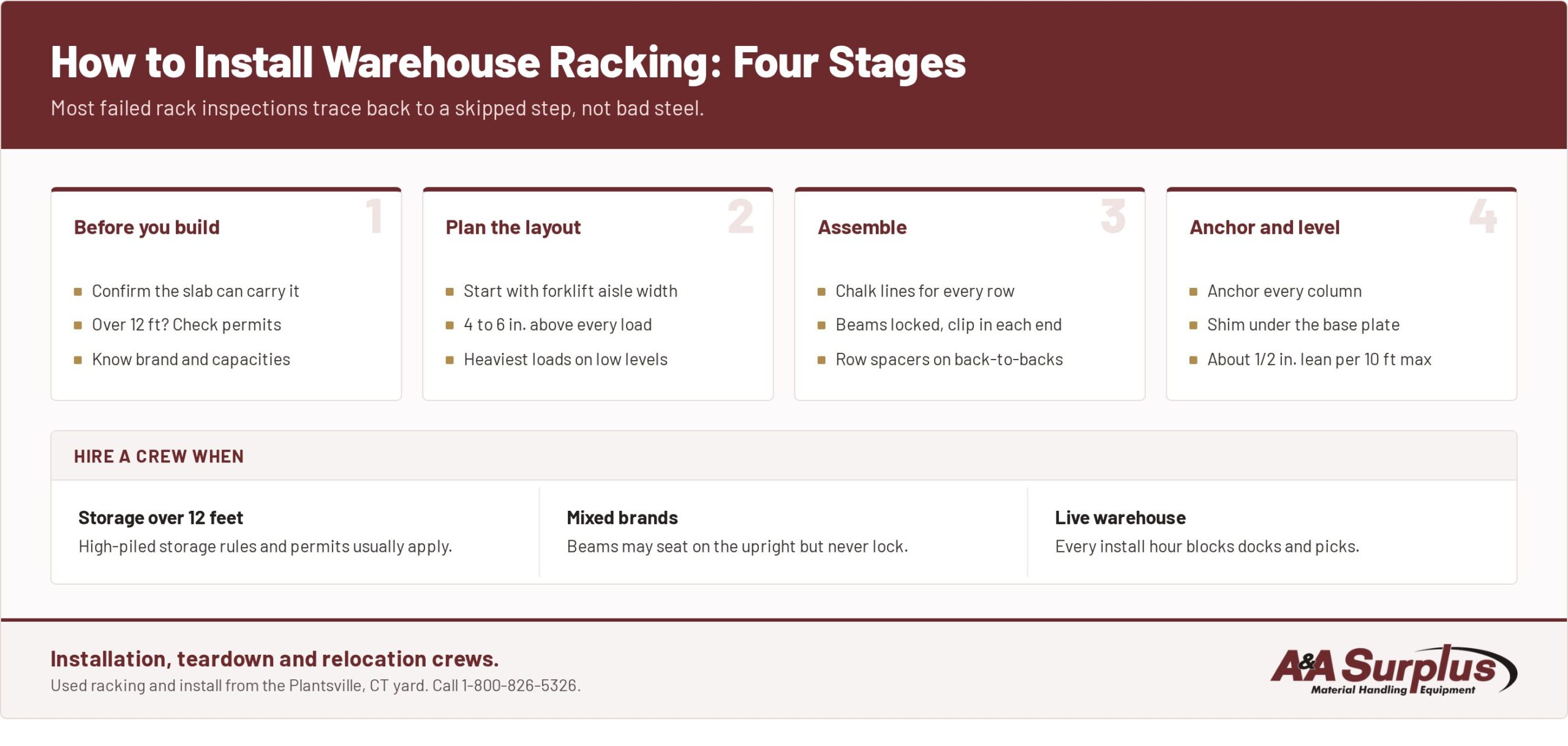
You need four things before the first upright goes vertical: a floor that can carry the load, a permit check, a drawn layout, and capacity information for every component you plan to use.
- A sound slab. Each rack column puts its whole share of the bay’s weight onto a small base plate. Cracked, heaved or very thin concrete needs an engineer’s opinion before you anchor into it.
- A permit answer. Under the International Fire Code, storage with a top-of-storage height over 12 feet counts as high-piled combustible storage and brings sprinkler, aisle and permit requirements (IFC Chapter 32). Call your local building and fire officials early.
- A layout drawing. Show row locations, aisle widths, beam elevations, flue spaces between back-to-back rows, and clearances to sprinklers, lights, doors and exits.
- Capacity data. Know the brand, upright frame capacity and beam capacity at your beam spacing. Our guide to pallet rack weight capacity explains how beam spacing changes what a frame can hold.
If you’re buying second-hand racking, collect the original manufacturer labels or brand and series before installation day, not after.
How Do You Plan a Warehouse Racking Layout?
Plan the layout around your lift truck first, then fit rows to the building. The aisle width your forklift needs to turn and stack at a right angle decides how many rows you get, and every other dimension follows from that number. Racking is only one part of the floor plan, and our warehouse layout design guide covers product flow, staging and dock space around it.
| Lift truck type | Typical aisle width | What it means for your layout |
|---|---|---|
| Sit-down counterbalance forklift | 11 to 13 feet | Fewest rows per building, but the truck works the dock and the yard too |
| Stand-up counterbalance forklift | 10 to 12 feet | Gains a row in most buildings over a sit-down truck |
| Reach truck | 8 to 10 feet | Common choice for selective pallet rack in mid-size warehouses |
| Turret or order picker (very narrow aisle) | 5 to 7 feet | Highest density; usually needs a very flat floor and guide rails or wire guidance |
Once aisles are set, place beam levels. Leave at least 4 to 6 inches between the top of each load and the beam above it so the operator can lift and clear the pallet without striking steel. Put the heaviest loads on the lowest levels and keep the top load below sprinkler heads by the clearance your fire code requires.
How to Install Pallet Racking, Step by Step
A standard selective pallet racking installation follows the same sequence on almost every job, whether the steel is new or used.
- Snap chalk lines. Mark the front and back face of every row on the floor so the first frame and the last one land on the same line.
- Lay out the parts. Stage uprights, beams, safety clips, base plates, shims and anchors at each row. Check every upright and beam for bends and cracked welds before it goes up.
- Stand the first two frames. Set two uprights on the line, connect them with a pair of beams at the lowest level and one higher level, and you have a freestanding bay to build from.
- Set beams at the drawn elevations. Seat each beam connector fully into the upright and tap it down until it locks. Install a safety clip or locking bolt in every beam end.
- Continue down the row. Add one frame and one set of beams at a time. Keep the row straight to your chalk line as you go.
- Add row spacers. Back-to-back rows get row spacers to hold the flue space and tie the two rows together.
- Level, shim and anchor. Covered in the next section. Do this before any load goes on the rack.
- Add decking and accessories. Install wire decks or pallet supports, end-of-aisle guards and load plaques.
Beams that only rest in the slots without locking can lift out when a forklift fork catches the underside. A missing safety clip is one of the most common findings on any rack inspection.
How Do You Anchor and Level Pallet Racking?
Anchor every column to the floor through its base plate, and plumb each frame before it carries a load. The Rack Manufacturers Institute’s MH16.1 standard requires every column to be anchored, aisle columns and rear columns alike, each on its own base plate (RMI on rack anchoring).
- Use the anchor the manufacturer specifies. Size, embedment depth and hole diameter come from the rack maker or a project engineer, not from what’s left in the truck.
- Shim under the base plate, not around it. Use steel shims sized to the base plate to correct floor slope, and stack them only as high as the manufacturer allows.
- Check plumb with a level on two faces. A frame that leans front to back or side to side carries less than its rating. The common industry limit is about half an inch of lean for every 10 feet of height.
- Torque and recheck. Tighten anchors to spec, then recheck plumb. Anchors can pull a frame out of line as they set.
We cover drill depth, anchor types and slab issues in more detail in our post on anchoring pallet racks.
Can You Install Used Warehouse Racking Yourself?
Yes, a small selective rack job is a reasonable do-it-yourself project for a crew that has a lift, a hammer drill and someone who can read a layout drawing. Larger or taller jobs tend to cost more in mistakes than they save in labor.
Doing it in-house works when the system is a few rows of standard teardrop rack, under 12 feet tall, on a good floor, with no permit drawings required. Hiring a crew makes more sense when any of these apply:
- Storage over 12 feet that triggers high-piled storage rules and a permit
- Mixed brands, where hole patterns and beam connectors may not match
- Very narrow aisle layouts that need floor flatness surveys and guide rail
- A live warehouse, where install time means blocked docks and lost picks
- Teardown of an existing system first, which is slower and riskier than new assembly
A&A Surplus runs professional installation, teardown and relocation crews alongside the used inventory on its 15-acre Plantsville, Connecticut yard, so the same team that sells the steel can set it.
What Are the Most Common Racking Installation Mistakes?
The mistakes that fail inspections are almost always the small ones: missing safety clips, skipped anchors and beams set at heights the rack was never rated for.
- Leaving out anchors on interior frames to save time
- Changing beam heights after installation without checking the new frame capacity
- Mixing brands so beams seat but never lock
- Undersized aisles that force operators to turn tight and clip uprights
- No load plaques, so nobody on the floor knows what each level can hold
- Bare end-of-aisle uprights in forklift traffic, the first columns to get hit. Column protectors are cheap next to a replacement upright.
What Should You Inspect After Installation?
Walk the whole system before it takes product, then keep inspecting on a schedule. The Rack Manufacturers Institute recommends inspecting high-traffic areas quarterly and immediately after any forklift impact (RMI inspection guidance).
On the first walk, check that every beam has its clip, every column has its anchor, every frame is plumb, row spacers are in, and load plaques are posted at the end of each row. After that, look for bent or creased uprights, bent beams, damaged base plates and loose anchors. A damaged upright gets unloaded and replaced, not straightened in place.
Frequently Asked Questions
How long does it take to install warehouse racking?
A few rows of standard selective pallet rack often go up in a day or two with an experienced crew and a lift. Permits, teardown of an old system, tall frames and very narrow aisles all add time, so get the drawing approved before you book the crew.
Do you need a permit to install pallet racking?
Often, yes. Most jurisdictions using the International Fire Code require a permit when top of storage exceeds 12 feet, and many building departments want drawings for tall rack regardless of what it holds. Ask your local building and fire officials before buying the steel.
Does pallet racking have to be anchored to the floor?
Yes. The RMI’s MH16.1 standard requires every rack column to be anchored to the floor. Anchoring keeps frames from walking or tipping when a forklift bumps the rack or a load is set down hard.
Can used pallet racking be installed the same way as new?
Yes, as long as every upright and beam passes inspection and the brand and capacity are known. Used rack follows the same layout, anchoring and plumb rules as new, and it should go up with new anchors and safety clips.
Planning a Racking Project in the Northeast?
Send your building dimensions, ceiling height and lift truck model, and the A&A Surplus team will tell you what’s in stock on the yard, how many pallet rack bays the space can hold and whether our crew can install it.
389 Marion Ave, Plantsville, CT 06479. Call 1-800-826-5326.